
Sell-through rate (STR) is a performance metric that measures the percentage of inventory sold compared with the total stock received during a specific period. In the fashion industry, it shows how fast a collection or item is selling and how shoppers react to it.
By tracking STR, brands and retailers can identify bestsellers early and adjust their stock levels with actual market demand, minimizing excess inventory and heavy markdowns strategies.
In this blog, we will explain what sell-through means in fashion, how to calculate it, what a good rate looks like, how brands can use it to make better decisions, and strategies to improve sell-through.
What is Sell Through in Fashion?
Sell through in fashion is a metric that shows how much of the stock received has been sold during a specific period. It helps brands and retailers understand how fast products are moving and whether customer demand is strong enough to support current inventory levels.
Unlike broader metrics like inventory turnover, which calculates how many times your entire average inventory is sold and replaced over a longer period, such as a year, sell-through tells you if a specific collection, category, or item is selling well or sitting too long in stock.
For fashion businesses dealing with short seasons, fast-changing trends, and tight margins, sell-through can shape better inventory and pricing decisions. A strong sell-through rate can show healthy demand, while a weak one may point to issues with pricing, product choice, timing, or stock planning.
How to Calculate Sell Through Rate in Fashion?
Formula: Sell-Through Rate (%) = (Units sold ÷ Units received) × 100
- Units Sold: The total number of items actually purchased by customers during the period.
- Units Received: The total inventory received from a manufacturer, supplier, or warehouse at the beginning of that period.
For example: If a boutique receives 500 units of a specific seasonal jacket and sells 300 units within the first 30 days, the sell-through rate is: (300 ÷ 500) × 100 = 60%. This means the brand sold 60% of the stock it brought in during that period.
To ensure the sell-through rate result accurate, follow these fashion industry standards:
- Select the Right Timeframe: In fashion, sell-through is typically calculated every 30 days or on a seasonal basis. For high-turnover fast fashion or peak periods like Fashion Week, tracking on a weekly basis provides more immediate data for replenishment.
- Segment by Granularity: Calculate rates for individual SKUs, colors, and sizes rather than just total category volume to identify specific bestsellers.
- Track by Channel: If you sell through multiple channels, calculate sell-through separately for DTC e-commerce, wholesale partners, and consignment locations to see which platform is performing best.
- Use Cost Value for Financials: While unit-based calculation is standard for inventory, retailers also divide the purchase value of items sold by the purchase value of delivered items to understand the financial performance of a collection.

Why is Sell Through Important for Fashion Brands?
Better buying and replenishment: Sell-through data allows planners to make smarter purchasing decisions for which to reorder and which should not be bought again. Strong rates can support quick restocks, while weak rates can stop extra stock from piling up.
Margin protection: Tracking sell-through early helps teams spot slow-moving products mid-season and respond in time with better product presentation, re-merchandising, or markdowns. So, brands have a better chance to clear stock without using deep discounts that hurt overall profit.
Improved cash flow: Inventory ties up capital. When products sell faster, brands lower storage expenses and carrying costs, freeing more room to invest in new collections, marketing, or growth.
Useful customer insight: Sell-through shows what customers really want. If certain colors, fits, or product types keep selling well, brands can use that data to shape future collections and plan production more accurately.
What is a Good Sell-Through Rate in Fashion?
The average strong sell-through benchmark for fashion retail often ranges from 60% to 80%. However, sell-through rate is just a relative number, depending heavily on your business model, product category, and where you are in the seasonal lifecycle. Different sectors aim for different targets to balance profitability with brand equity.
Here are common benchmarks by fashion sector:
|
Fashion Sector |
Target STR |
Strategic Rationale |
| Fast Fashion |
80% – 100% |
Products go out of date very quickly, so brands need to sell them fast before trends change. |
| Mid-Market / Contemporary |
60% – 70% |
Brands need a healthy sales pace while still keeping enough stock to avoid losing sales. |
| Luxury & Designer |
45% – 55% |
Lower sell-through can help keep products rare and protect the brand’s premium image. |
| Core Essentials (Basics) |
Steady & Consistent |
These products sell over a longer time, so brands focus more on stable demand and regular restocking than fast sell-out. |
Full-price sell-through rate: Many retailers aim to sell around 70% of a collection at the original price before the first markdown starts.
- Healthy performance: Achieving 70% full-price sell-through helps protect profit because the remaining stock can be cleared later through discounts without hurting the whole season too much.
- Warning sign: If sell-through is below 50% before sale season, it often means the product needs quick action. Brands may need to improve product display, run targeted promotions, work with influencers, or start markdowns earlier to move stock and recover cash.
Timeline Benchmarks: When to Track Sell-Through?
- Weekly: Best for fast fashion or limited drops. It helps brands spot strong sellers quickly and restock them before demand slows down.
- Monthly: A common schedule for reviewing the performance of seasonal collections and checking overall stock health.
- Post-season: Many fashion brands aim for a final sell-through rate of around 90% to 95% after clearance. Keeping too much unsold stock into the next season can increase storage costs and hurt profit.
IMPORTANT: 100% sell-through is not always perfect. It means everything sold, but it can also mean the brand bought too little and missed extra sales because products sold out too early.
How to Read Sell Through Without Misleading Yourself?
Sell-through is useful, but it does not tell the full story on its own. A low rate does not always mean the product is weak, and a high rate does not always mean everything went right. Fashion brands need to read sell-through together with product type, season timing, price, stock depth, and store/channel allocation.
When low sell-through signals overbuying?
Sometimes the product is fine, but the brand simply brought in too much stock.
Common signs:
- Sales are steady, but inventory is still too high;
- Many sizes or colors are left over across channels;
- Similar products are also moving slowly because supply is too heavy.
What it usually means:
- The buy was too deep for the expected demand;
- Reorder decisions were too aggressive;
- The brand overestimated how much the market could absorb.
When low sell-through signals weak product-market fit?
In some cases, low sell-through points to a product that customers do not really want.
Common signs:
- Traffic or store exposure is decent, but conversion stays low;
- The product gets views, but not enough purchases;
- Other items in the same category are selling better.
What it usually means:
- The style, color, fit, or design is not connecting with shoppers;
- The product may not match current trends or customer needs;
- The collection may be too far from what the brand’s audience expects.
When low sell-through is caused by price or promotion?
A product may have demand, but the pricing or promotion strategy is blocking sales.
Common signs:
- Customers show interest, but hesitate to buy;
- Sales improve only when promotions start;
- Similar products at a lower price move faster;
What it usually means:
- The price feels too high for the market;
- The value is not clear enough to justify the price;
- Promotion timing or campaign support is too weak.
When low sell-through is caused by size curve or allocation issues?
The issue is where the stock went and which sizes were available, not actually the product itself.
Common signs:
- Some stores sell out quickly, while others sit on stock;
- Popular sizes are missing, but weak sizes remain;
- Online demand is strong, but store inventory is not balanced.
What it usually means:
- The size curve was not planned well;
- Inventory was sent to the wrong stores or channels;
- Allocation was too broad or too slow to adjust.
When high sell-through is actually a missed-sales warning?
A high sell-through rate looks positive, but it can also show that the brand did not buy enough.
Common signs:
- Products sell out very early;
- Bestselling sizes disappear too fast;
- Customers leave because stock is no longer available.
What it usually means:
- Demand was stronger than expected;
- The initial buy was too low;
- The brand may have lost extra revenue because it ran out too soon.
How to Improve Sell Through in Fashion?
Improving sell-through in fashion is about helping the right products sell faster at the right time. Here are 5 common strategies that fashion brands and retailers can apply:
Data-Driven Merchandising and Buying
Leveraging latest technologies is an effective way to align inventory with consumer demand.
- Better Forecasting: Use AI-powered trend forecasting to quantify the adoption of specific prints, colors, and silhouettes before the season begins.
- Real-Time Adjustments: Monitor daily or weekly sales velocity to identify hot SKUs and trigger automated replenishment.
- Assortment Planning: Prioritize high sell-through styles for future collections and cancel reorders for underperforming items early to prevent excess stock.
>> Read more:
- A Complete Guide to Demand Sensing in Fashion Supply Chain
- Top 7 AI-Powered Demand Forecasting Tools for Fashion
Strategic Markdown and Promotion Management
Instead of broad, margin-eroding discounts, use sell-through data to drive targeted actions.
- Early Intervention: Identify slow movers mid-season and implement targeted markdowns or re-merchandising strategies before the products become obsolete.
- Bundle Offers: Combine popular items with slower-moving stock to offload excess inventory without sacrificing overall brand value.
- Clearance Strategy: Aim to achieve a 70% sell-through rate at full price before beginning clearance sales to ensure season-wide profitability.
Marketing and Brand Visibility
Marketing can help move stock faster, especially for products that need more attention.
- Influencer collaborations: Brands can work with influencers or launch small capsule collections to create interest and push faster sales.
- Social commerce: Instagram Stories, Reels, and regular posts can bring more traffic to products that need stronger visibility.
- Sustainability messaging: Showing eco-friendly materials or responsible production can help attract shoppers who care about sustainability.
>> You may need:
- Zero Waste Fashion: From Overproduction to AI Optimization
- Overproduction in the Fashion Industry: An In-depth Analysis
Omnichannel Inventory Optimization
Managing inventory across channels helps brands move stock faster and avoid leaving products in the wrong place.
- Channel reallocation: Move stock from weak stores, regions, or channels to places where demand is stronger.
- Consignment management: Track sell-through at retail partners closely to make sure products are placed where they can actually sell.
- DTC integration: Connect ecommerce and physical store inventory so high-demand items can reach more shoppers.
>> Explore further: Top 7 Omni Channel Inventory Management Software Solutions
Staff and Store Performance
The human element remains critical for in-store sell-through success.
- Sales Rep Analytics: Compare sell-through by sales representative and region to identify top-performing teams and reward high conversion rates.
- Visual Merchandising: Regularly update in-store displays to feature items with high potential but lower-than-expected sell-through.
Common Sell-Through Mistakes Fashion Teams Make
Using one benchmark for every category:
Setting a universal 70% sell-through goal for the entire store is a cause for poor inventory health. You can’t treat high-volume fast fashion items the same as luxury ones or core basics. In fact, high-trend items need near-perfect sell-through to avoid obsolescence, while luxury items intentionally maintain lower rates to maintain brand exclusivity.
Waiting too long to act:
Many teams only review sell-through reports at the end of a month or season. This passive monitoring misses the opportunity for mid-season course correction, leading to bad clearance strategies at the end of season. Successful teams use weekly sales velocity data to trigger immediate reorders of bestsellers or re-merchandise slow-moving stock before the season peak passes.
Discounting too early:
Low sell-through does not always mean a product needs a price cut right away. The mistake is marking items down too early before checking other ways to improve sales. Sometimes the real issue is poor product placement, wrong channel allocation, or not enough visibility. A product has ability to sell better with stronger merchandising, better social promotion, or influencer support.
Ignoring size-level data:
Only looking at the performance of the style rather than the SKU means you only look at a healthy overall sell-through without seeing underlying broken inventory. Like, a style may have an 80% sell-through rate, but if Medium and Large are sold out while XS and XL are overstocked, the brand is likely missing sales and may still end up discounting the leftover sizes later.
Ignoring full-price sell-through:
A high sell-through rate achieved through heavy discounting is not a success, it is a liquidation. Industry experts aim for a 70% full-price sell-through. If your STR only hits targets after 50% off sales, your buying and demand forecasting strategies need a total overhaul.
How Nūl Can Help Track and Improve Sell Through Rate?
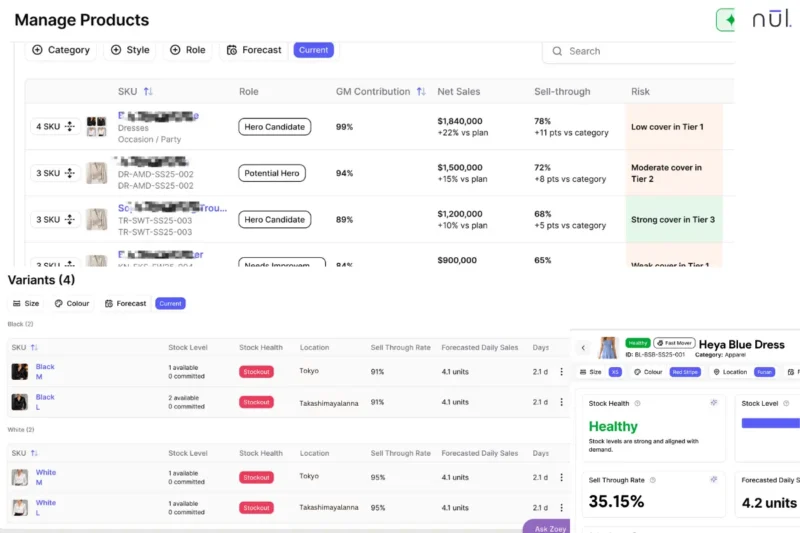
Nūl gives fashion teams a clearer view of sell-through across products, brands, and categories. Instead of checking sales in one place and stock in another, teams can see performance, risk, and product priorities in one dashboard, then act faster when items are underperforming or selling out too quickly.
Demand forecasting: Plan better before the season starts.
- Use current sales and product performance to compare actual results with plan.
- Spot products that are ahead of plan or falling behind.
- Support better buy depth decisions for future orders.
- Make it easier to avoid overbuying weak styles and underbuying strong ones.
Trend detection: See demand shifts earlier.
- Track which brands, products, or categories are improving in sell-through.
- Spot fast movers before the trend fades.
- Identify products gaining momentum.
- Faster action on winners while demand is still strong.
Size curve planning: Understand whether the issue is the product or the size mix.
- Show sell-through at product level, not only at top-line level.
- Identify styles that sell well but may be missing key sizes.
- Better size planning for future buys.
- Reduce the risk of leftover weak sizes and missing bestselling ones
Allocation recommendations: Place stock where it has the best chance to sell.
- Compares sell-through across brands and products.
- Help teams see which items are strong, weak, or at risk.
- Support smarter movement of stock across categories, channels, or product groups.
- Makes it easier to shift inventory away from weak performers and support stronger ones
Replenishment triggers
Nūl can help teams restock winners at the right time.
- Highlights products with strong sell-through and strong sales contribution
- Helps teams act before top items go out of stock
- Supports faster reordering of high-performing products
- Reduces missed sales caused by late replenishment
Conclusion
Sell-through helps fashion brands understand product demand, control inventory better, and make faster decisions during the season. It can guide buying, replenishment, pricing, and markdown timing, while also helping reduce overstock and protect profit.
But to use it well, brands need to read sell-through in context. Product type, season stage, channel performance, size mix, and margin all matter. When tracked carefully, sell-through becomes a strong decision-making tool for improving both sales and inventory health.
Also, leverage advanced technologies, AI-driven software to make tracking and improving sell-through more efficient.