
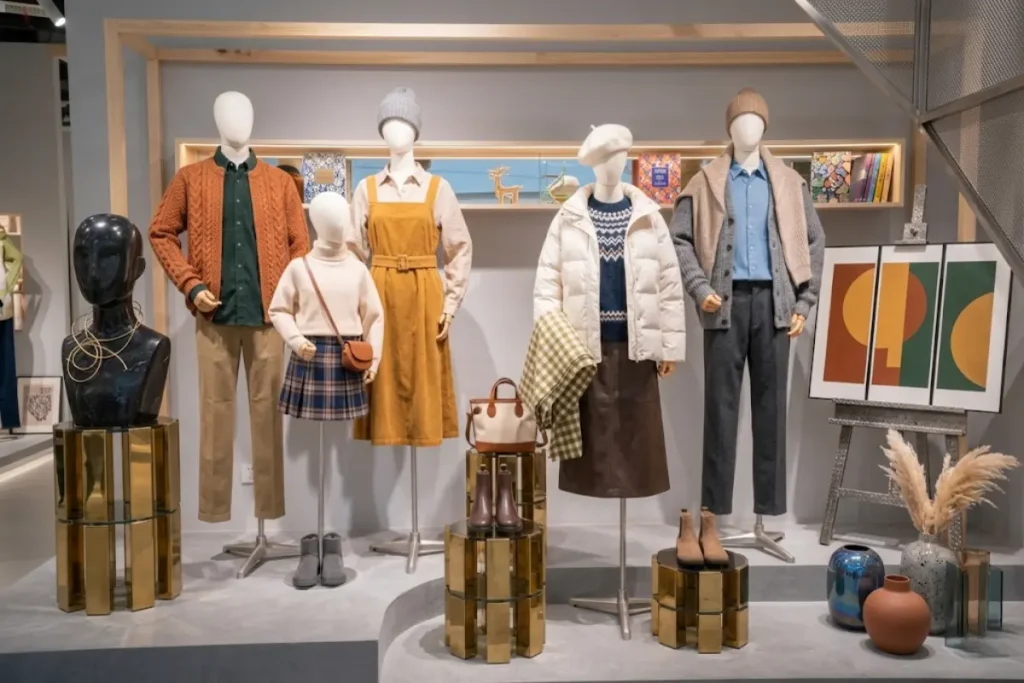
In fashion, product mix is the combination of product categories (e.g., tops, bottoms, dresses, and accessories), styles, price points, and variations a brand or retailer offers to customers. The biggest aim of product mix is that the collection matches customer demand and supports sales, margin, and inventory health.
In this article, we explain what fashion product mix means, how it works, what elements shape a strong mix, and how businesses can build a product mix that is easier to sell, manage, and grow. Also, you can know how to optimize product mix by shifting from historical analysis to predictive demand sensing.
What Is Product Mix?
Product mix is the complete assortment of products a business offers, structured by product lines (width), total number of items (length), variations within each product such as size or color (depth), and how closely related those products are (consistency).
Let’s break down 4 dimensions of a product mix:
- Width (Breadth): The number of different product categories (e.g., outerwear, knitwear, accessories).
- Length: The total number of SKUs across all categories.
- Depth: The number of variations per product (sizes, colors, styles).
- Consistency: How closely related your product lines are in style, use, target audience, production, distribution, or brand DNA.
For example, a women’s fashion brand may have:
- Width: 4 categories: tops, bottoms, dresses, outerwear.
- Length: 120 total SKUs.
- Depth: Each item available in 5 sizes and 3 colors (= Depth of 15).
- Consistency: All products designed for office wear.
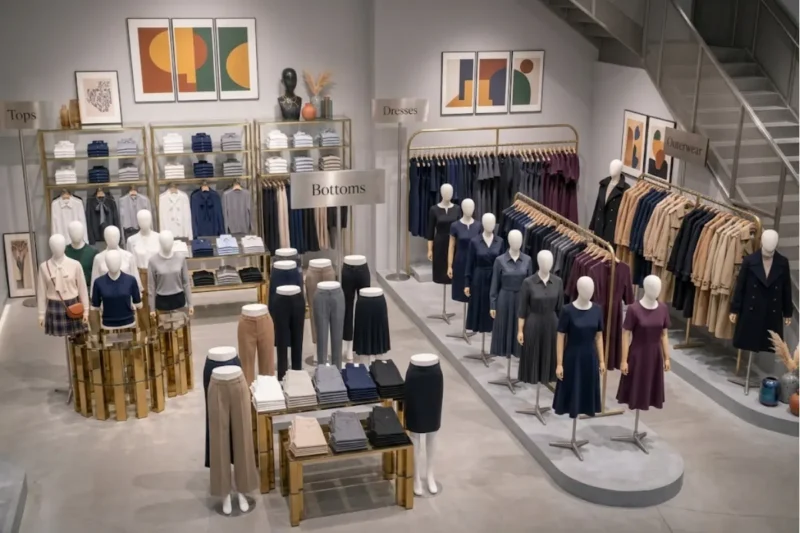
Why Is Product Mix Important in Fashion?
Product mix is important in fashion because it directly controls what sells, what does not, and how much profit a collection can generate. A well-balanced mix helps brands meet customer demand, sell products faster, and avoid excess inventory.
Lower revenue risk
By spreading inventory across different product types, the business doesn’t depend on a single category or trend. If a seasonal trend such as neon colors does not sell as expected, steady demand from core products like black leggings can offset the loss and protect overall revenue.
Higher inventory return (GMROI)
Some products sell often and bring healthy margins, while others take up space without adding much value. So, product mix helps brands put more inventory budget into categories that perform well and less into products that move slowly. As a result, the same inventory investment can generate better sales and stronger profit.
Better stock availability in bestsellers
A product may sell well in general, but if key sizes or colors run out too quickly, the brand still loses revenue. A well-planned mix supports better availability in the variations (depth) customers actually buy most. Thus, bestsellers are more enough and reduce missed sales caused by broken size curves or incomplete assortments.
Stronger customer lifetime value
One product can bring customers in for the first sale, but related categories, matching items, or logical next-purchase options gives customers a reason to come back. In that way, product mix supports both acquisition and retention, not just short-term conversion.
Wider market reach through category expansion
Expanding product categories allows brands to reach new customer segments. Each new category creates an additional entry point for different needs and use cases. For example: A dress-focused brand adding handbags can attract customers who may not initially be looking for apparel.
The Core Elements of a Product Mix Strategy
Category Mix
The category mix is the distribution of inventory across core groups (e.g., Tops, Bottoms, Outerwear, Footwear).
A balanced category mix ensures the brand covers different customer needs without overloading one category while neglecting others. For example, if too much inventory is placed in dresses while demand is spread across multiple categories, the business can face overstock in one area and missed sales in others.
Style Mix
There are 3 types of style:
- Basics: Low-risk, high-volume staples for steady cash flow.
- Fashion/Trend: High-margin, time-sensitive items that respond to current market trends or specific seasons.
- Statement Pieces: Low-volume items used for brand positioning and PR.
A balanced style mix avoids over-reliance on either too boring or too risky products. Instead, it combines stability with variation to keep the collection both sellable and relevant.
Price-Point Mix
The price-point mix defines how products are distributed across entry, mid-range, and premium levels.
- Entry-Level: Attract new customers with lower margins.
- Mid-Range: Drive volume and create primary revenue.
- Premium/High-End: Contribute higher margins or brand positioning.
With a balanced price-point mix, the brand serves different customer budgets while controlling margin.
Size Mix
Size mix means distributing stock across different sizes within each product. In fashion, demand is not spread equally across all sizes. Some sizes sell faster and in higher volume. If size distribution is not aligned with real demand, the brand may end up with unsold extreme sizes while missing sales in popular ones.
A well-planned size mix improves product availability, reduces broken assortments, and supports higher sell-through.
Color and Print Mix
In fashion, we have:
- Neutrals/Safe Colors: Provide continuity and reduced markdowns (e.g., Black, White, Navy).
- Trend Colors/Prints: Create seasonal excitement but carry a shorter shelf-life.
Neutrals sell more consistently and are easier to carry across seasons, while bold colors grab attention and drive traffic but have higher risks. Brands have to maintain stable sales, but still introduce newness into the collection.
How to Build the Right Fashion Product Mix?
Building the right fashion product mix starts with one practical goal: offer enough choice to drive sales without creating unnecessary stock risk.
Start with the Customer, Not the Trend
Always analyze your customer’s purchasing behavior firstly:
- Who they are: Are they buying for a specific event or everyday life?
- What they buy repeatedly: Find the items that keep customers coming back. These are your most important products.
- The Problem: Does your collection solve a specific need (e.g., “comfortable work clothes”)? If a piece doesn’t solve that need, cut it.
Identify Your Core Revenue Drivers
Every product in your mix should have a specific job:
- Repeat Sales: These items (like basic tees) bring in steady, predictable cash.
- Basket Lifters: Small items (like socks or hats) that customers add to their order at the last minute.
- Brand Image: Unique pieces that get people to click on your site, even if they end up buying a basic shirt instead.
Balance Basics, Volume Drivers, and Trends
A strong fashion product mix usually combines basics, volume drivers, and trend items, because each one supports the business in a different way.
A collection with too many basics may feel flat and unexciting, thus you must sell at the lowest price to compete. A collection built too heavily around trends can become unstable, you risk losing money on unsold stock because demand changes quickly and markdown risk rises.
Decide How Wide and How Deep to Go
This is about how you spend your money:
- Too Wide: You sell too many types of things (hats, shoes, pants, jackets). This confuses customers and makes your brand feel messy.
- Too Deep: You buy too many units of just one color or one style. If that style doesn’t sell, your money is trapped in the warehouse.
The best approach is to expand width only when a new category has a clear purpose, and increase depth only where demand is proven. In other words, growth in assortment should follow evidence, not assumption.
Build Around Category Roles
A more practical way to build product mix is to assign a clear role to each category. This makes the assortment easier to plan and review over time.
A useful structure looks like this:
- Core Products: Always available, never goes out of style.
- Traffic Drivers: Trendy items that grab attention online.
- Margin Boosters: Higher-priced items that make you the most profit.
- Add-ons: Small, cheap items used to increase the total bill.
- Brand-Building: Unique pieces that show off your brand’s personality.
This approach helps answer an important planning question: Why is this category in the assortment at all? If a category has no clear commercial or brand role, it may be taking up budget and inventory without contributing enough value.
Match the Mix to Your Business Model
Your strategy depends on how you run your business:
| Business Model | Product Mix Focus | Strategic Priority |
| Startup Brand | Narrow & Shallow | Focus on 5 – 10 “Hero” items to conserve cash and reduce complexity. |
| Premium Label | Narrow & Deep | High consistency and perfect fit to build luxury trust and design identity. |
| Fast-Fashion | Wide & Shallow | High newness and trend turnover with low stock levels per style. |
| Boutique Retail | Broad & Shallow | A curated variety that helps customers build complete, unique outfits. |
| Multi-Brand Store | Curated Breadth | Managing category overlap to prevent brands from stealing sales from each other. |
- A startup fashion brand usually needs a tighter mix. Too many categories too early create complexity and stock risk. It is often better to focus on a few clear strengths.
- A premium label may need fewer products overall, but stronger consistency, clearer design identity, and more brand-building pieces.
- A fast-fashion player often needs more newness, faster product turnover, and a higher share of trend-driven items, but still needs enough core products to stabilize demand.
- A boutique retailer usually needs a balanced mix that combines proven sellers with distinctive pieces that help the store feel curated.
- A multi-brand store has to think more carefully about overlap, because the mix is not only about individual products but also about how brands and categories work together without cannibalizing each other.
A Simple Fashion Product Mix Framework You Can Use
|
Category |
Budget % | Role in Your Business |
Risk Level |
| Core Styles | 40–50% | The foundation; items that sell all year and never go out of style. | Low |
| Seasonal Refresh | 20–25% | Your best-sellers but in new seasonal colors or updated fabrics. | Medium-Low |
| Trend Bets | 10–15% | High-fashion items following viral trends; limited stock only. | High |
| Add-ons | 10–15% | Accessories or small items that encourage customers to buy more. | Low |
| Statement Items | 5–10% | Expensive, unique pieces used for marketing and brand image. | Very High |
But, you need to adjust the framework by brand type. Let’s consider:
| Brand Type | Priority Element | Primary Goal |
| Minimalist | Core (70%+) | High repeat-purchase rate |
| Occasionwear | Seasonal & Statement | High margin per unit |
| Fast-Fashion | Trend Bets (40%+) | High inventory turnover |
| Boutique | Add-ons & Statement | High Average Order Value (AOV) |
4 Typical Strategies for Product Mix Optimization
Product mix cannot be fixed, brands need to adjust it over time to improve sales, reduce risk, and respond to market changes. Each strategy focuses on a specific type of change in the product mix.
Expansion
Expansion means adding new product lines (Width) or increasing variations (more colors, sizes, or styles) within existing lines (Depth).
Example: A footwear brand launching an apparel line (Width) or adding a wider range of sizes/colors to its best-selling sneaker (Depth).
Objective: Reach new customer segments and create more selling opportunities.
Risks: Increases inventory complexity, higher overhead, fragmented focus and requires stronger demand planning.
Solution: Use pre-order testing for testing demand before committing to a full production run.
Contraction
Product mix contraction is removing underperforming products, styles, or entire categories with weak demand to simplify the portfolio.
Example: A brand discontinuing a low-margin accessories line to focus resources on its high-growth outerwear category.
Objective: Improve GMROI by eliminating “Zombie SKUs” and freeing up capital tied up in slow-moving stock.
Risks: Immediate revenue loss, create gaps for competitors to fill, and can affect loyal customers who rely on specific items.
Solution: Check if the item you’re deleting is often bought alongside a best-seller.
Modification
Modification means updating existing products in the mix to improve their relevance or performance without launching a completely new SKU.
Example: Re-releasing a classic handbag style in a trending seasonal color or updated eco-friendly material.
Objective: To extend the Product Life Cycle (PLC) of a core item by aligning it with current trends or feedback.
Risks: Destroying the “original” value that made the product a success.
Solution: Release the update as a “Limited Edition” alongside the original.
Differentiation
Differentiation varies the mix to create a unique value proposition that distinguishes the brand from competitors.
Example: A traditional menswear brand (selling standard cotton chinos) begins adding 4-way stretch, moisture-wicking fabric, and wrinkle resistance to their pants.
Objective: To reduce direct price competition by offering exclusive features, designs, or technical specifications
Risks: High production costs that the market may not be willing to pay for.
Solution: Conduct customer surveys to verify that customers actually want the new feature you’re building.
How Product Mix Connects to Product Life Cycle (PLC)?
Every product moves through four stages. Your strategy for Width (how many types) and Depth (how many units) must change at each stage.
Introduction Stage: Test Breadth Carefully
In this stage, you are launching a new style. You don’t know yet if it will be a hit.
- Strategy: Use Width over Depth.
- Action: Launch a few different styles or colors, but only buy a small number of units for each.
- Goal: Use this stage to listen to the market without risking too much money.
Growth Stage: Deeper Investment in Winning Categories
Once a product starts selling fast, you need to commit to it.
- Strategy: Shift from Width to Depth.
- Action: Stop launching new experimental styles and put your money into making sure your bestsellers are always in stock. Add more sizes and the most popular colors.
- Goal: Maximize sales while the product is popular.
Maturity Stage: Optimize Margin and Replenishment
At this stage, sales are steady but no longer growing. The product is now a “Core” item.
- Strategy: Support stronger margins, better inventory replenishment, and tighter inventory control.
- Action: Cut out the weak colors or sizes that aren’t moving. Use automated reordering to keep stock levels lean.
- Goal: Keep the product profitable for as long as possible with the lowest possible effort.
Decline Stage: Reduce Exposure and Plan Replacement
Eventually, every trend or style loses its appeal.
- Strategy: Contraction (Shrink the mix).
- Action: Stop restocking. Start small discounts to clear out the remaining units. Do not wait until the warehouse is full of dead stock to act.
- Goal: Exit the product cleanly to free up cash for the next “Introduction” stage.
How AI Can Help Optimize Product Mix?
AI helps optimize product mix by turning sales, inventory, and customer data into clear decisions about what to keep, expand, reduce, or remove.
Demand-based mix planning
AI analyzes historical sales, seasonality, and current demand signals to identify which categories, styles, and variations are most likely to perform.
- predicts demand by SKU, size, and channel
- highlights categories with growing or declining demand
=> Build a product mix based on expected performance, not assumptions.
SKU performance and mix cleanup
AI evaluates each product’s contribution to revenue, margin, and sell-through.
- identifies slow-moving or low-impact SKUs
- flags long-tail products that add complexity without value
=> Remove weak products and keep the assortment focused and efficient.
Depth optimization for bestsellers
AI detects which sizes, colors, and variations sell fastest within each product.
- recommends where to increase or reduce depth
- prevents “broken assortments” in high-demand items
=> Improves product availability and reduces missed sales.
Trend detection and mix adjustment
AI tracks emerging trends using real-time data such as search behavior, social signals, and sales velocity.
- detects early demand shifts
- suggests when to introduce or scale trend-driven products
=> React faster without overcommitting inventory too early.
Markdown and lifecycle optimization
AI monitors product performance across its lifecycle and recommends actions at the right time.
- identifies when products start slowing down
- suggests targeted markdowns or exit timing
=> Reduce overstock and protects margins.
Channel-based product allocation
AI analyzes how products perform across DTC, retail, wholesale, and marketplaces.
- recommends where each product should be allocated
- adjusts inventory distribution based on channel demand
=> Improve sell-through and reduces imbalance across channels.
Continuous mix optimization
AI does not treat product mix as a one-time decision.
- updates recommendations as new data comes in
- helps teams rebalance categories, depth, and inventory regularly
=> Keep the product mix aligned with real demand over time.
Conclusion
Fashion product mix is not just about what products a brand offers. It is a structured way to control how products perform, how inventory is managed, and how the business grows. A strong mix connects customer demand, product roles, and inventory decisions into one clear system.
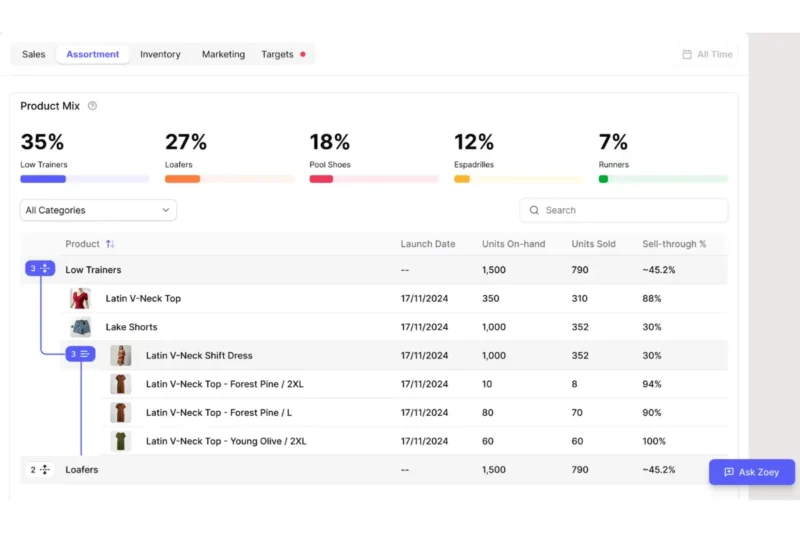
AI can make this process faster and more accurate. Instead of relying only on manual review, teams can use AI to detect weak SKUs, identify winning categories, optimize size depth, track demand shifts, and support better product mix decisions across channels. This helps brands respond earlier, reduce guesswork, and improve mix quality with more confidence.