" height="22.21672870003851px" id="z3WvM4hhx" transform="translate(0 7.783)" width="44.5160044463523px"/><path d="M 0 0 L 2.973 0 L 2.973 29.237 L 0 29.237 Z" fill="rgb(51, 51, 65)" height="29.23683002950565px" id="JHCCz3Moo" transform="translate(52.332 0)" width="2.9732091795568465px"/><path d="M 0 0 L 18.335 0 L 18.335 2.973 L 0 2.973 Z" fill="rgb(88, 93, 247)" height="2.9732091795568505px" id="TtL1Ujsfx" transform="translate(26.217 3.072)" width="18.334926489198978px"/><path d="M 0 1.817 C 0 0.813 0.813 0 1.817 0 C 2.82 0 3.634 0.813 3.634 1.817 C 3.634 2.82 2.82 3.634 1.817 3.634 C 0.813 3.634 0 2.82 0 1.817 Z" fill="rgb(88, 93, 247)" height="3.633967846768943px" id="E_sZ1ZJZP" transform="translate(57.862 26.217)" width="3.6339678467688827px"/></g></svg>)
Fashion Retail Store Clustering: Methods, Process, Best Practices
Store clustering means grouping stores that share similar characteristics like store capacity, climate, sell-through, customer base, etc. for assortment planning.

Nūl Content Team
An Experienced Research & Knowledge Team
The Nūl Content Team combines expertise in technology, fashion, and supply chain management to deliver clear, practical insights. Guided by Nūl’s mission to end overproduction, we create content that helps brands forecast demand more accurately, optimize inventory, and build sustainable operations. Every piece we publish is grounded in real-world experience, ensuring it’s both credible and actionable.

Table of contents
An apparel chain buys the same outerwear collection for every store. The Minneapolis location sells through its coats by November, while the Miami store is still discounting them in February, when it should already be selling lightweight layers. The problem is not the collection itself, but the same buy, same season in different climates.
The question is how can retailers plan more accurately for each store? In fact, no planner can plan a separate assortment, size run, and markdown strategies for every location in a large retail chain. Instead, store clustering is an optimal fix by grouping stores with similar characteristics, then retailers plan for each cluster.
This guide explains what store clustering is, the methods and algorithms used to create clusters, the steps involved, common mistakes, and the role of machine learning.
What Is Store Clustering?
Store clustering is the process of grouping stores that share similar characteristics such as climate, sell-through, customer profile, store format, or capacity, so retailers can plan assortment, allocation, and pricing by group instead of by individual store.
For example, a Minneapolis store and a Chicago store can sit in the same cluster if both sell heavy outerwear at a similar pace, even though they are in different cities.
The term “store clustering" is often used interchangeably with “store segmentation” and “store tiering”, but the three are not the same.
Store tiering ranks stores by one measure, usually sales volume, into tiers such as A, B, and C.
Store segmentation groups stores by fixed attributes, such as size or region, regardless of how customers actually shop.
Store clustering goes further: it groups stores by actual behavior like what sells, how fast, to whom, so the groups reflect real demand rather than just geography or size.
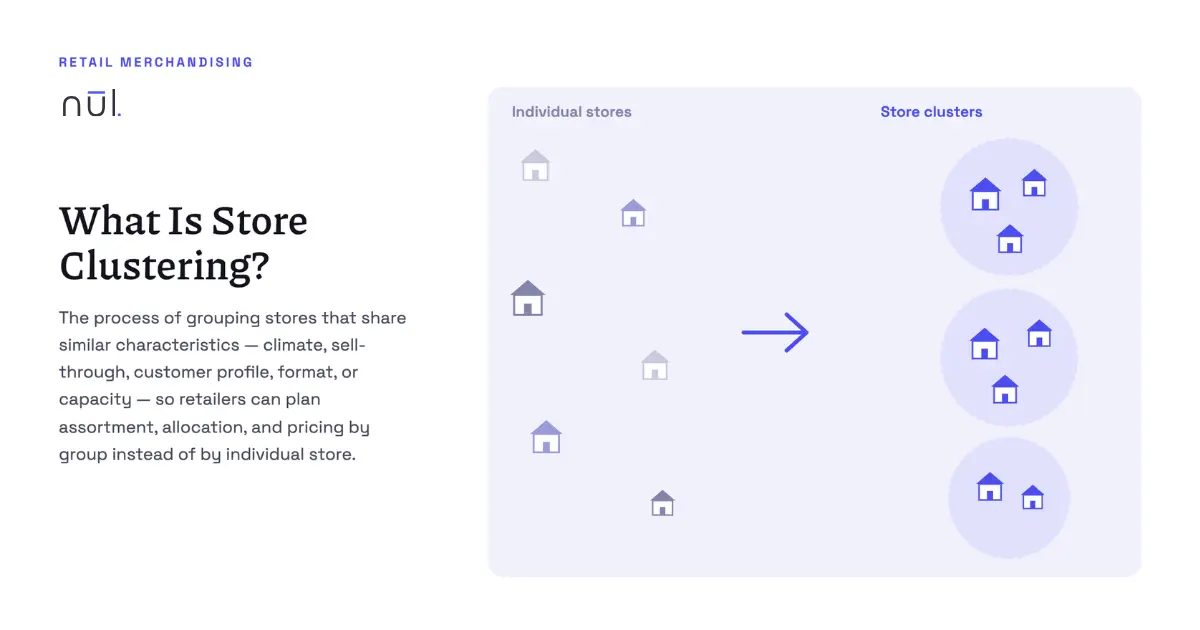
Store clustering is the process of grouping stores that share similar characteristics.
Why Store Clustering Matters?
The benefits of store clustering fall into three areas: assortment relevance, inventory efficiency, and forecast accuracy.
Assortment relevance: When a retailer plans by cluster, each store carries the styles, sizes, and depth that match its own customers, instead of a chain-wide average that fits no store particularly well. A store in a fast-moving outerwear cluster gets more coats and deeper size runs. A store in a year-round basics cluster gets a different mix entirely.
Inventory efficiency: If a store's inventory matches what it actually sells, it needs fewer markdowns to clear excess stock and runs into fewer stockouts on items customers want. Instead of shifting inventory between stores mid-season to fix a mismatch, the mismatch is smaller from the start.
Improved forecast accuracy: Forecasting every store individually spreads thin, noisy data across too many models. Forecasting the whole chain as one unit hides the differences between stores. Clustering sits between the two: a planner forecasts demand for a group of similar stores, which smooths out random noise while keeping the pattern specific to that group.
Store Clustering Methods and Techniques
The 7 below methods cover most of what retailers use in practice, from simple capacity groupings to full multi-dimensional models. Most retailers start with one or two of the simpler methods and add complexity as their data and planning maturity grow.
Capacity-Based Clustering
Capacity-based clustering groups stores by how much product they can physically hold with criteria like selling space, shelf count, distinct styles displayed, units held per style.
A 3,000-square-foot store and an 8,000-square-foot store can't carry the same assortment depth regardless of how similar their customers are, so capacity sets a hard constraint before any other clustering happens. It's usually the first pass a retailer runs, since square footage rarely changes season to season while a sell-through pattern might.
Climate-Based Clustering
Climate-based clustering groups stores by weather pattern, typically temperature and seasonality, since climate drives when a store needs a seasonal category and how much of it to carry.
The climate-driven method is one of the oldest clustering methods in apparel retail, and one of the simplest to maintain, since a store's climate does not change from year to year. It is usually the second way applied after capacity, before finer distinctions like customer demographics or price sensitivity come into play.
Geodemographic-Based Clustering
Geodemographic-based clustering groups stores by fixed characteristics beyond capacity: location type, mall class, area income, cultural makeup of the customer base.
A downtown flagship in a fashion-forward neighborhood might cluster with other urban stores skewing toward trend items. Whereas, a suburban mall store clusters with others skewing toward classic pieces. This method works well for a new store or product line with no sell-through history yet.
Sales-Performance Clustering
Group stores by how a specific category performs rather than overall store sales. A store can rank top-group for denim and middle-group for outerwear, since customers behave differently by category even within the same store.
Sales-performance clustering is more granular, and usually needs clustering software rather than a spreadsheet once categories multiply across hundreds of stores.
Productivity-Based Clustering
Groups stores by how efficiently they turn inventory into revenue: revenue or gross margin per square foot, unit sales per style. For example, two stores have the same floor size, but one sells twice as many units per square foot.
The productivity-based clustering method is useful for deciding how much total inventory a store should carry, separate from which styles.
Price-Based Clustering
Group stores by how customers respond to price: full-price versus markdown mix, demand shift when price changes. The price-based clustering is typically layered on top of another method, since price sensitivity rarely determines what to stock, it determines how that stock should be priced and promoted.
Machine-Learning Clustering
This clustering method combines several dimensions (sales, capacity, demographics, price sensitivity, etc.) into one model using algorithms instead of manual rules.
Common methods include:
K-means: Groups stores around a fixed number of cluster centers. For example, K-means divide 100 stores into five groups based on sales, store size, and customer profile.
Hierarchical clustering: Treats each store as a separate group at first, then gradually merges stores with similar sales, customers, or other characteristics. Planners choose the point where the groups are practical to use.
K-medoids: Works like k-means but uses an actual store as the center of each cluster. This can make each group easier to understand.
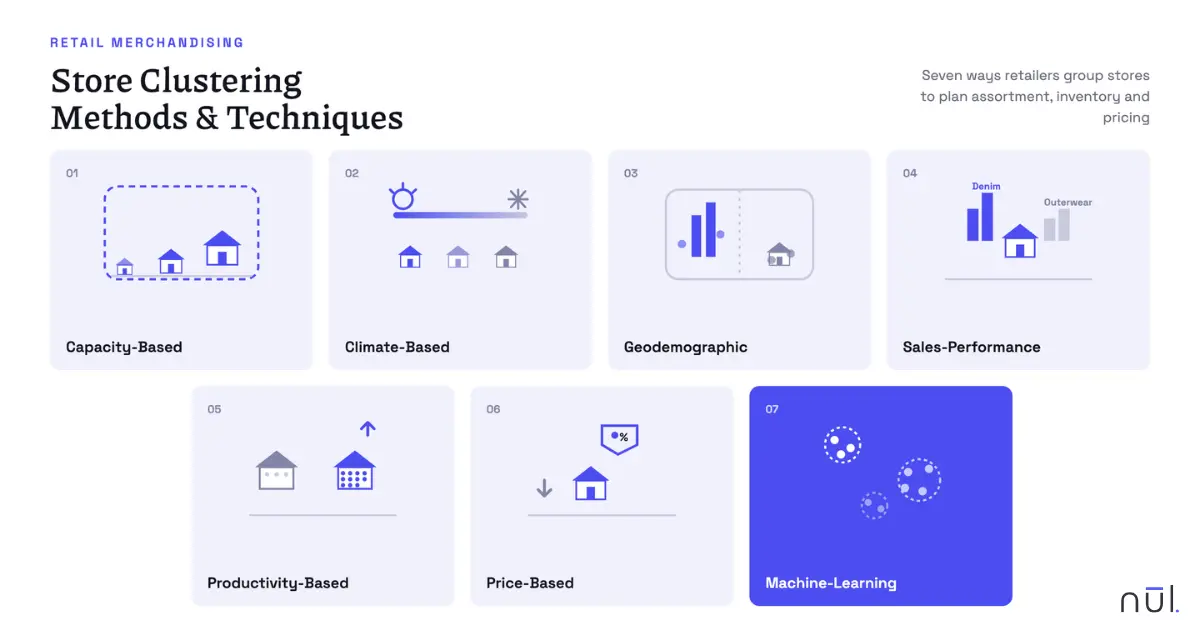
Store Clustering Methods and Techniques
How to Build a Store Cluster?
Choosing a clustering method is only the input. Building a cluster that actually works in production follows a consistent process
Step 1: Define the Decision the Clusters Will Drive
Before collecting data, a planner needs to know what the clusters are used for. Assortment, pricing, allocation, and replenishment clusters require different data and grouping logic. Without a clear purpose, the clusters describe stores accurately but fail to support any useful action.
Step 2: Collect and Clean the Data
Gather what the decision requires: POS history, store master data (size, location, climate), and demographic data where relevant. Clean data matters more than more data because a model built on inconsistent product codes or missing sales history produces clusters that look precise but aren't reliable.
Step 3: Select Attributes and a Clustering Method
A retailer with thin sales history can start with climate and capacity clustering. One with several clean seasons of POS data can move to sales or multi-dimensional clustering. The method should match the data available, not the other way around.
Step 4: Run the Clustering and Determine the Number of Clusters
The algorithm runs (k-means, hierarchical, or k-medoids) and produces an initial set of clusters. Tools such as the elbow method and silhouette score can help estimate a suitable number of clusters. However, the first result should be treated as a draft rather than a final answer.
Step 5: Validate Clusters Against Business Logic
A statistically clean cluster can still be operationally useless. Check drafts against constraints the algorithm doesn't know, like supply chain zones or a store that's an outlier for a reason the data doesn't capture. Adjust manually before rollout.
Step 6: Name Clusters Neutrally
Avoid names such as A, B, and C because they can make clusters appear ranked. Use descriptive names such as Urban Trend, Warm-Climate Casual, or Small Suburban instead. The name should describe the cluster, not suggest that one group is better than another.
Step 7: Apply Clusters to Planning
A cluster only matters once it's built into the systems planners actually use: assortment, allocation, replenishment, pricing. One that lives only in an analytics tool changes nothing on the floor.
Step 8: Monitor and Re-Cluster
Store behavior can change after a new competitor opens, a store is remodeled, or the local customer base shifts. Review clusters on a regular schedule, such as before each major season, and update them when the differences become meaningful.
Common Store Clustering Mistakes (and How to Avoid Them)
Averaging Hides Important Differences:
Two stores can have the same average sell-through but very different sales patterns. One sells steadily throughout the season, while another sees short demand spikes. Grouping both as “medium-performing” can lead to the wrong replenishment plan.
Using Different Methods Across Teams:
A supplier group stores by pack size, while the retail planning team groups them by sell-through speed. These methods can place the same store in different clusters and create conflicting assortment or inventory recommendations.
Retailers need one shared clustering framework, with clear definitions, inputs, and ownership.
Creating More Clusters Than the Team Can Manage:
An algorithm identifies twelve statistically distinct groups, but the planning team is only able to manage four or five assortments or size curves. Extra clusters add complexity without creating value if teams eventually combine them manually or cannot maintain separate plans.
Resisting Store Reassignment:
A store needs to move to a different cluster after its sales pattern changes. However, managers or planners may resist the change because the new cluster appears less important or receives a smaller inventory allocation.
Cluster assignments should follow current business evidence rather than internal preferences or past status.
Forcing Outlier Stores Into a Standard Cluster:
Some stores behave differently from the rest of the chain. For example, a store near a stadium experiences sharp sales spikes on game days. Forcing that store into the closest standard cluster can distort the group’s average while still producing a poor plan for the outlier. These stores need a separate rule, manual plan, or exception group.
Using a Proxy Instead of the Real Demand Driver:
Retailers often use climate zones as a proxy for weather-driven demand. However, climate zones describe typical conditions, not what happens in a specific season.
An unusually cold period in a warm region increases coat demand even though the store’s climate label has not changed. Whenever possible, retailers should combine fixed attributes with current sales, weather, or customer-behavior data.
How is Machine Learning and AI used in Modern Store Clustering?
Traditional clustering can be run manually once or twice a season. Machine learning does not change the basic purpose of clustering, but it makes the process faster, more detailed, and easier to repeat as new data arrives.
Managing More Stores and Variables
A planner can cluster 120 stores using sales and climate data. However, clustering 1,200 stores across many categories, customer groups, price levels, and sales patterns creates too many combinations to review manually.
Machine learning can process these variables across the full store network and update the results automatically. Work that once took several days each season can become part of a regular data pipeline.
Finding Patterns That Averages Miss
The averaging problem from the pitfalls above (opposite sell-through shapes landing in the same "medium" cluster) is exactly what ML is better positioned to catch. ML can compare full sales curves across hundreds of stores at once instead of single summary numbers by eye. It doesn't make the trap disappear, it makes it more likely to surface if the model is built to look for it.
Continuous Re-Clustering
Manual re-clustering runs on a schedule because doing it more often isn't practical by hand. An automated pipeline can flag a store the moment its behavior differs from its cluster instead of waiting for the next scheduled review.
For example, a cold spell may suddenly increase outerwear demand in a normally warm region. The system can flag that the store no longer behaves like the rest of its cluster.
What Can Nūl Support Store Clustering?
Nūl supports store clustering in two ways: by preparing the store-level data needed to build reliable clusters and by applying cluster-based plans across the retail network.
On the data side, Nūl connects sales, inventory, product, and store data from ERP, POS, and e-commerce systems in one place. This gives retailers a cleaner and more consistent dataset for creating, validating, or updating store clusters.
Once clusters are defined, Nūl’s Assortment Optimization and Allocation Agent can apply the relevant assortment and size curve to stores within each group. They can also adjust recommendations for individual store differences that a cluster-level plan can not fully capture.
The Rebalancing Agent continuously compares each store’s sell-through with its cluster and flags unusual changes. This helps planners identify stores that need different inventory actions or reassignment without waiting for the next scheduled cluster review.
Every recommendation requires human approval, so planners remain responsible for deciding whether a store should move to another cluster or stay in its current group.
Conclusion
Store clustering works when it changes three things: what each store carries, how much markdown it needs, and how accurate its forecast is. If a clustering program isn't moving those three, the clusters need to be rebuilt, not relabeled.
Start with the constraint that's cheapest to fix like capacity and climate before adding customer attributes, category performance, or price sensitivity. Validate every cluster against what the algorithm can't see, name clusters neutrally, and put a re-clustering schedule on the calendar instead of waiting for a bad season to force the review.
Looking for more? Dive into our other articles, updates, and strategies



Let's show you how