Best Inventory Management Software with Bill of Materials

7 Best Inventory Management Software with Bill of Materials

Nov 28, 2025

Nūl, Unleashed, Fishbowl, Katana, Cin7, OpenBOM, and MRPeasy are the 7 best inventory management software with Bill of Materials (BOMs) for fashion brands.
The modern fashion industry runs on speed, precision, and low waste. For any fashion brand that designs and produces its own products, the Bill of Materials (BOM) is more than a parts list, it is the DNA of every garment. 

Each style, color, and size depends on an accurate list of fabrics, linings, trims, labels, packaging, and care tags. When the BOM is wrong or disconnected from your inventory system, everything will be messy: overbuying some materials, running out of key components, delaying production, and creating phantom stock. 

This article will help you prevent these troubles by introducing the best 7 inventory management software with Bill of Materials features, through a fashion lens. We’ll focus on how they handle apparel BOMs, variants, and material consumption so your brand can choose a suitable solution.

>> Explore further: A Complete Guide to Batch Production in the Fashion Industry

Software

Focus

Key BOM Strengths

Best For

Nūl

Fashion-native AI inventory optimization

High-growth D2C apparel brands needing SKU-level control and AI-driven inventory decisions.

Unleashed

Wholesale, distribution, & e-Commerce

  • Real-Time COGS calculation

  • Easy disassembly of finished goods

  • MRP purchasing suggestions

Small to mid-sized fashion brands needing strong stock control and straightforward production.

Fishbowl

QuickBooks-integrated manufacturing

  • Integrated labor/time costing (accurate COGM)

  • Seamless QuickBooks sync

  • Detailed lot/batch tracking.

Brands that manufacture and also handle repairs/alterations with QuickBooks-style accounting.

Katana

Real-time MRP & production planning

  • Live master planning for production priority

  • Real-time allocation of raw materials

  • Multi-level BOMs with operations tracking

DTC and wholesale fashion brands running cut-and-sew production and multiple sales channels.

Cin7

Multi-channel retail & wholesale

  • Assembly/kitting for finished goods

  • Inclusion of labor/overhead service fees

  • Strong multi-channel fulfillment readiness

Retail-led fashion brands selling across ecom, marketplaces, and wholesale.

OpenBOM

Product design & PLM collaboration

  • Real-time collaboration across teams

  • Vendor RFQ generation

  • Flexible Revision Control for design changes

Brands with complex product structures and heavy product-data collaboration.

MRPeasy

Manufacturing ERP

  • Matrix-BOM for size/color variations

  • Scrap/Wastage tracking

  • Quick Cost & Lead Time Estimation

Fashion brands with structured factory-style production and detailed routing requirements.


Nūl

Nūl is an Agentic inventory optimization platform with the aim to solve the complex problems of the fashion industry. With Nūl, your inventory is tracked at the granular level of size, color, and style.

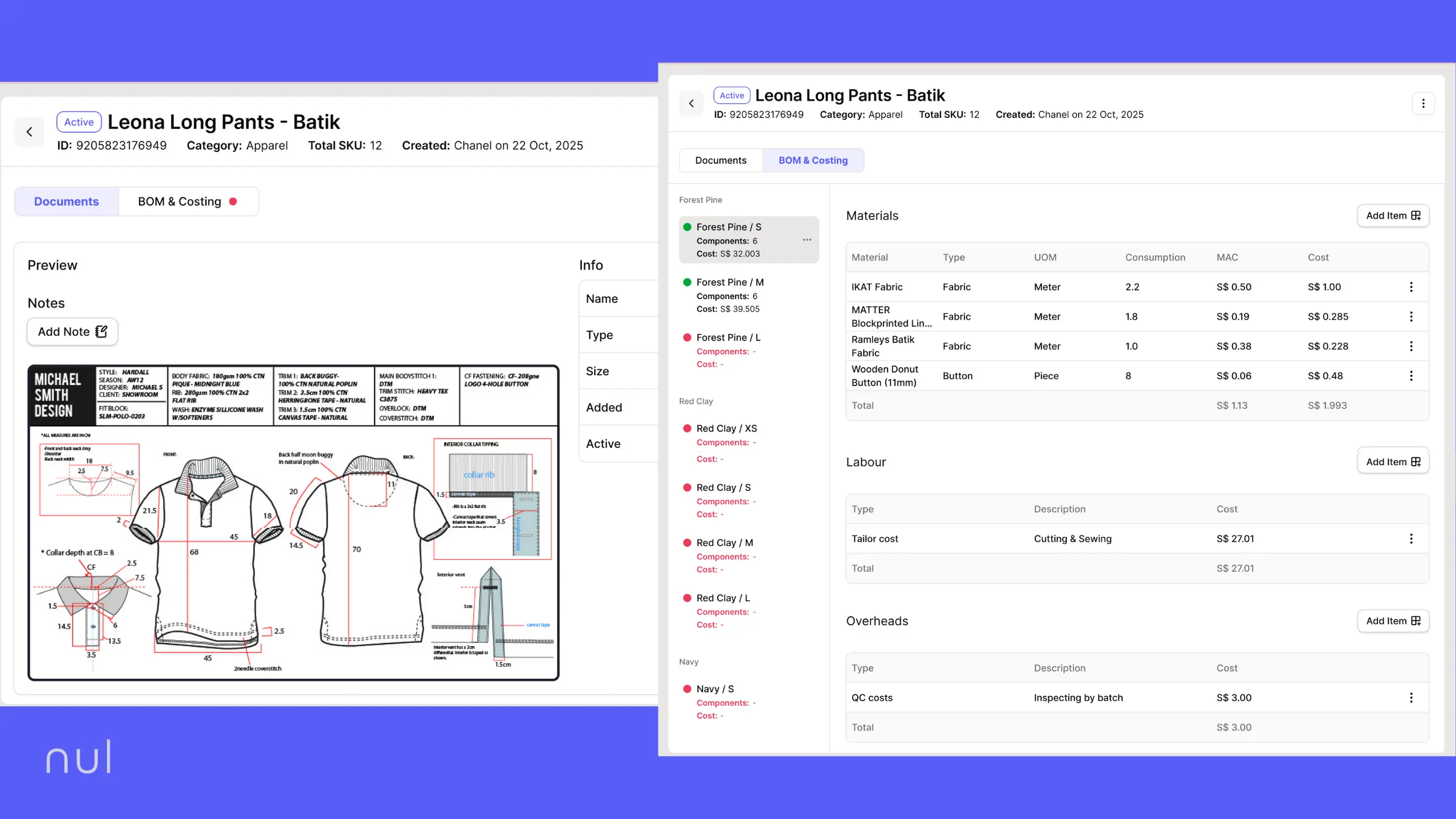
The Bill of Materials (BOM) feature in Nūl serves as the fundamental costing and production source of truth. Unlike traditional systems where BOMs can be static, Nūl leverages this detailed data to power its AI-driven features.

Key BOMs features:

  • Use multi-level BOM to show total SKUs per product and component counts per variant.

  • Link the BOM with supporting documents and tech packs (e.g., design sketches, stitching details, trims, and material specs)

  • Centralize raw material costs, labor, and overheads (QC, shipping) into a single, comprehensive COGM record.

  • Structured material breakdown for fabrics, linings, trims, labels, buttons, and packaging, all pulled from one materials library.

  • Calculate component totals and final garment cost for each size/color variant to help merchandisers check margin per SKU, not just per style.

  • Because BOMs are standardized and linked to materials, Nūl’s AI can use them to forecast fabric demand, prevent overbuying, and optimize production timing.

The Bill of Materials (BOM) feature in Nūl

The Bill of Materials (BOM) feature in Nūl.


Unleashed

Unleashed Software is a cloud-based inventory management system for manufacturers, distributors, and wholesalers. It controls inventory, order purchasing, production, and sales with a single platform. 

Used across many industries including fashion, its Bill of Materials (BOM) provides a structural framework for assembly and disassembly, linking raw material inventory to the manufacturing process for real-time stock control and precise costing.

Key BOMs features:

  • Build BOMs that clearly outline all materials, components, and steps required to assemble a finished garment.

  • ​​Track and include all costs beyond materials, such as labor, logistics (freight/customs), wastage, and packaging costs, to reveal precise profit margins.

  • Use multi-level BOMs to manage layered or component-heavy fashion products.

  • Manage auto-assembled products to quickly create bundles or kitsets (e.g., a shirt packaged with a scarf) with flexible components.

  • Work with forecasting tools to identify component requirements based on BOM needs, ordering the right quantity of stock and avoiding production delays.

  • Automatically reverse the assembly process to manage returns or excess finished goods back into usable components/raw materials.

  • Ensure end-to-end traceability of components (like fabric dye lots or trims) and finished products for quality control and managing product recalls.

Unleashed's Bill of Materials (BOM) provides a structural framework.

Unleashed's Bill of Materials (BOM) provides a structural framework for assembly and disassembly.


Fishbowl Inventory

Fishbowl Inventory is a long-standing manufacturing and warehouse management solution with advanced inventory and production features. For fashion brands that cut and sew in-house or with partners, it can act as a central hub to manage materials, assemblies, and finished styles. 

Fishbowl's BOM features are famous for Manufacture and Work Orders. It lets teams define every component, track labor and other costs at each step, and turn approved BOMs into work orders with less manual setup.

Key BOMs features:

  • Capture materials, labor, and other costs (cutting, stitching, and finishing) for each step so total build cost is visible from start to finish. 

  • Support multiple BOM types (manufacture, maintenance, disassemble, repair)

  • Convert BOMs into Manufacture Order with a click and trigger Work Order automatically based on BOM rules and demand.

  • Create customizable BOM templates with images and notes to standardize how each product is picked and built across runs and factories. 

  • Sync BOM cost data with accounting tools like QuickBooks so manufacturing costs flow straight into your financials without double entry.

  • Support Disassembly BOM, which is useful for identifying the parts to retain or discard when handling returns or scrapping aging inventory.

Fishbowl's BOM features are famous for Manufacture and Work Orders.

Fishbowl's BOM features are famous for Manufacture and Work Orders.


Katana

Katana is a cloud-based Material Requirements Planning (MRP) and inventory platform for modern manufacturers (B2C, B2B, and hybrid). It  provides a real-time, centralized view of the entire manufacturing process, linking demand (sales orders) directly to production and raw material management.

The Bill of Materials (BOM) in Katana is a powerful Master Planning feature. When a sales order is placed for a finished garment, the system checks the BOM against stock availability, automatically allocating materials, and suggesting accurate purchasing and production deadlines.

Key BOMs features:

  • Create multi-level BOMs with subassemblies, ideal for layered garments.

  • Manage both the finished product variants (size/color) and the raw materials (BOM components).

  • Tie BOMs directly to live inventory so fabric, trim, and packaging consumption updates stock levels and drives reordering. 

  • Use the BOM to prioritize manufacturing tasks based on sales order deadlines and the availability of all required raw materials

  • Automatically track manufacturing costs based on the BOM and associated production operations.

The Bill of Materials (BOM) in Katana is a powerful Master Planning feature.

The Bill of Materials (BOM) in Katana is a powerful Master Planning feature.


Cin7

Cin7 is an inventory and order management platform for omnichannel brands. The system's manufacturing module (often Cin7 Core) focuses on the concept of Assemblies (driven by the BOM), which simplifies the creation of finished goods, kits, and multi-packs.

The Cin7 BOM helps manage the costs and inventory consumed during simple manufacturing or kitting operations. This tool is suitable for fashion brands that assemble finished garments or create multi-item product kits.

Key BOM features:

  • Support different BOM types (assembly, production, make-to-order) 

  • Map labor and machinery directly to BOMs to see capacity, efficiency, and the real cost of producing each style. 

  • Use make-to-order BOMs to manage customized garments (e.g., embroidery, prints, or special finishes).

  • Manage product families so variations like sizes, colors, and styles are grouped under one parent, keeping inventory and BOMs aligned for fashion assortments.

  • A well-structured BOM helps ensure necessary components are always available, reduce stockouts and prevent overstocking of specific parts.

The Cin7 BOM helps manage the costs and inventory.

The Cin7 BOM helps manage the costs and inventory.


OpenBOM

OpenBOM is a cloud-based BOM and product data platform that connects design, sourcing, and production in a single source of truth. Despite being widely used in engineering and manufacturing, it also fits fashion brands that need to control complex product structures and multiple external manufacturers or suppliers.

In OpenBOM, the Bill of Materials sits at the center of the workflow. BOMs are built from shared catalogs that store every item’s description, supplier, and cost, then organized into flexible product structures.

Key BOMs features:

  • Create flexible, multi-level BOMs linked to shared catalogs of materials and components, including supplier and cost data.

  • Integrate BOMs with CAD and other design tools so product structures and changes flow directly from design into OpenBOM.

  • Automatically calculate and roll up cost information from the raw material level up through all sub-assemblies to determine the final product cost.

  • Easily add custom properties (columns) to items and BOMs to handle the rich, non-standard data required for apparel.

  • Collaborate with internal teams and suppliers in a cloud workspace where everyone sees and edits the same live BOM.

The Bill of Materials sits at the center of the workflow in OpenBOM.

The Bill of Materials sits at the center of the workflow in OpenBOM.


MRPeasy

MRPeasy is a Material Requirements Planning (MRP) and ERP solution for small and mid-sized manufacturers. Its strength lies in complex manufacturing control and precise costing tools that are easy to implement and use.

The MRPeasy BOM is central to its planning modules, allowing brands to manage complex configurations, track wastage, and quickly calculate costs for quoting new styles. There are many BOM options like single-level for basic styles, multi-level for layered garments, and even matrix for configurable products or size/color grids.

Key BOMs features:

  • Create single-level and multi-level BOMs with any number of components, including sub-assemblies.

  • Use matrix BOMs and product configurators to manage parameters and variations, then automatically generate BOMs for each configuration.

  • Support disassembly and co-product BOMs to handle cutting rolls of fabric into many pieces or breaking down kits into components.

  • Link BOMs directly with production routings, so operations and material needs form one connected production model.

  • Leverage version control and revision history to track BOM changes over seasons, capsules, or fit updates.

>> Read more: Top 8 Best Raw Material Inventory Management Software

The MRPeasy BOM is central to its planning modules.

The MRPeasy BOM is central to its planning modules.


Conclusion

For modern manufacturing and fashion brands, an inventory management software with Bill of Materials (BOM) feature is the single most important factor for profitability and scale.

The reviewed software shows that the BOM is not only a static list of ingredients into a dynamic, but also an interconnected data structure. Choosing the right platform means linking the software's BOM strengths with your operational needs like:

  • Costing accuracy

  • Real-time production

  • Complex products & design control

Ultimately, a strong BOM ensures that every garment produced is cost correctly, every raw material is ordered precisely, and every SKU maintains its target margin. Hope you will have a suitable solution for your brands.

Nūl Content Team

Article by

Nūl Content Team

An Experienced Research & Knowledge Team

The Nūl Content Team combines expertise in technology, fashion, and supply chain management to deliver clear, practical insights. Guided by Nūl’s mission to end overproduction, we create content that helps brands forecast demand more accurately, optimize inventory, and build sustainable operations. Every piece we publish is grounded in real-world experience, ensuring it’s both credible and actionable.

LinkedIn Profile

More From Blog

Co-Build With Us

We are so keen to get this right. If the problem statement resonates, please reach out and we’d love to co-build with you so fits right into your existing workflow.

Co-Build With Us

We are so keen to get this right. If the problem statement resonates, please reach out and we’d love to co-build with you so fits right into your existing workflow.

Co-build with us
Co-build with us

Co-Build With Us

We are so keen to get this right. If the problem statement resonates, please reach out and we’d love to co-build with you so fits right into your existing workflow.

Co-build with us
Co-build with us

More From Blog

Best Inventory Management Software with Bill of Materials

7 Best Inventory Management Software with Bill of Materials

Nov 28, 2025

Nūl, Unleashed, Fishbowl, Katana, Cin7, OpenBOM, and MRPeasy are the 7 best inventory management software with Bill of Materials (BOMs) for fashion brands.

The modern fashion industry runs on speed, precision, and low waste. For any fashion brand that designs and produces its own products, the Bill of Materials (BOM) is more than a parts list, it is the DNA of every garment. 

Each style, color, and size depends on an accurate list of fabrics, linings, trims, labels, packaging, and care tags. When the BOM is wrong or disconnected from your inventory system, everything will be messy: overbuying some materials, running out of key components, delaying production, and creating phantom stock. 

This article will help you prevent these troubles by introducing the best 7 inventory management software with Bill of Materials features, through a fashion lens. We’ll focus on how they handle apparel BOMs, variants, and material consumption so your brand can choose a suitable solution.

>> Explore further: A Complete Guide to Batch Production in the Fashion Industry

Software

Focus

Key BOM Strengths

Best For

Nūl

Fashion-native AI inventory optimization

High-growth D2C apparel brands needing SKU-level control and AI-driven inventory decisions.

Unleashed

Wholesale, distribution, & e-Commerce

  • Real-Time COGS calculation

  • Easy disassembly of finished goods

  • MRP purchasing suggestions

Small to mid-sized fashion brands needing strong stock control and straightforward production.

Fishbowl

QuickBooks-integrated manufacturing

  • Integrated labor/time costing (accurate COGM)

  • Seamless QuickBooks sync

  • Detailed lot/batch tracking.

Brands that manufacture and also handle repairs/alterations with QuickBooks-style accounting.

Katana

Real-time MRP & production planning

  • Live master planning for production priority

  • Real-time allocation of raw materials

  • Multi-level BOMs with operations tracking

DTC and wholesale fashion brands running cut-and-sew production and multiple sales channels.

Cin7

Multi-channel retail & wholesale

  • Assembly/kitting for finished goods

  • Inclusion of labor/overhead service fees

  • Strong multi-channel fulfillment readiness

Retail-led fashion brands selling across ecom, marketplaces, and wholesale.

OpenBOM

Product design & PLM collaboration

  • Real-time collaboration across teams

  • Vendor RFQ generation

  • Flexible Revision Control for design changes

Brands with complex product structures and heavy product-data collaboration.

MRPeasy

Manufacturing ERP

  • Matrix-BOM for size/color variations

  • Scrap/Wastage tracking

  • Quick Cost & Lead Time Estimation

Fashion brands with structured factory-style production and detailed routing requirements.


Nūl

Nūl is an Agentic inventory optimization platform with the aim to solve the complex problems of the fashion industry. With Nūl, your inventory is tracked at the granular level of size, color, and style.

The Bill of Materials (BOM) feature in Nūl serves as the fundamental costing and production source of truth. Unlike traditional systems where BOMs can be static, Nūl leverages this detailed data to power its AI-driven features.

Key BOMs features:

  • Use multi-level BOM to show total SKUs per product and component counts per variant.

  • Link the BOM with supporting documents and tech packs (e.g., design sketches, stitching details, trims, and material specs)

  • Centralize raw material costs, labor, and overheads (QC, shipping) into a single, comprehensive COGM record.

  • Structured material breakdown for fabrics, linings, trims, labels, buttons, and packaging, all pulled from one materials library.

  • Calculate component totals and final garment cost for each size/color variant to help merchandisers check margin per SKU, not just per style.

  • Because BOMs are standardized and linked to materials, Nūl’s AI can use them to forecast fabric demand, prevent overbuying, and optimize production timing.
The Bill of Materials (BOM) feature in Nūl

The Bill of Materials (BOM) feature in Nūl.


Unleashed

Unleashed Software is a cloud-based inventory management system for manufacturers, distributors, and wholesalers. It controls inventory, order purchasing, production, and sales with a single platform. 

Used across many industries including fashion, its Bill of Materials (BOM) provides a structural framework for assembly and disassembly, linking raw material inventory to the manufacturing process for real-time stock control and precise costing.

Key BOMs features:

  • Build BOMs that clearly outline all materials, components, and steps required to assemble a finished garment.

  • ​​Track and include all costs beyond materials, such as labor, logistics (freight/customs), wastage, and packaging costs, to reveal precise profit margins.

  • Use multi-level BOMs to manage layered or component-heavy fashion products.

  • Manage auto-assembled products to quickly create bundles or kitsets (e.g., a shirt packaged with a scarf) with flexible components.

  • Work with forecasting tools to identify component requirements based on BOM needs, ordering the right quantity of stock and avoiding production delays.

  • Automatically reverse the assembly process to manage returns or excess finished goods back into usable components/raw materials.

  • Ensure end-to-end traceability of components (like fabric dye lots or trims) and finished products for quality control and managing product recalls.
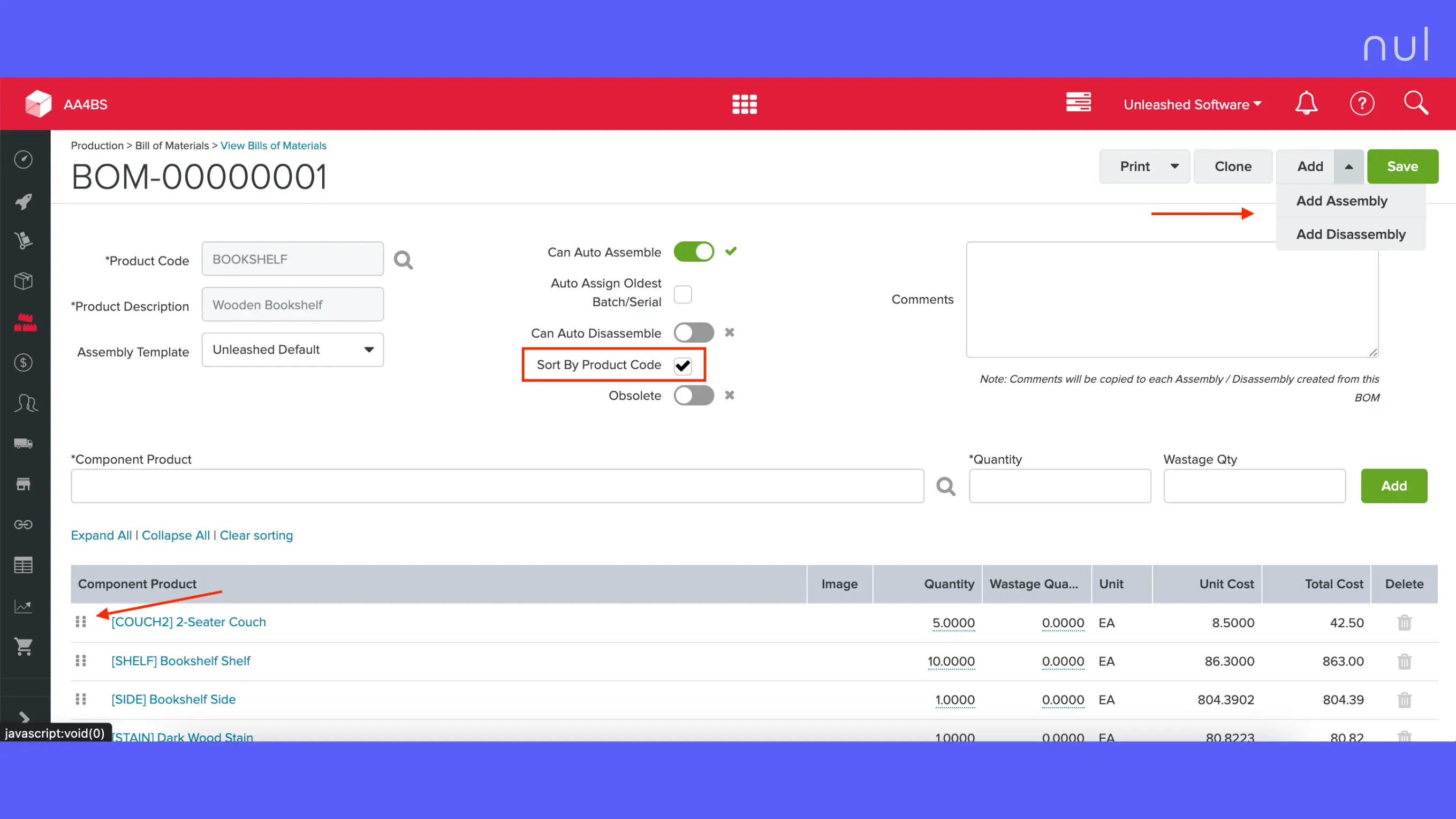
Unleashed's Bill of Materials (BOM) provides a structural framework.

Unleashed's Bill of Materials (BOM) provides a structural framework for assembly and disassembly.


Fishbowl Inventory

Fishbowl Inventory is a long-standing manufacturing and warehouse management solution with advanced inventory and production features. For fashion brands that cut and sew in-house or with partners, it can act as a central hub to manage materials, assemblies, and finished styles. 

Fishbowl's BOM features are famous for Manufacture and Work Orders. It lets teams define every component, track labor and other costs at each step, and turn approved BOMs into work orders with less manual setup.

Key BOMs features:

  • Capture materials, labor, and other costs (cutting, stitching, and finishing) for each step so total build cost is visible from start to finish. 

  • Support multiple BOM types (manufacture, maintenance, disassemble, repair)

  • Convert BOMs into Manufacture Order with a click and trigger Work Order automatically based on BOM rules and demand.

  • Create customizable BOM templates with images and notes to standardize how each product is picked and built across runs and factories. 

  • Sync BOM cost data with accounting tools like QuickBooks so manufacturing costs flow straight into your financials without double entry.

  • Support Disassembly BOM, which is useful for identifying the parts to retain or discard when handling returns or scrapping aging inventory.
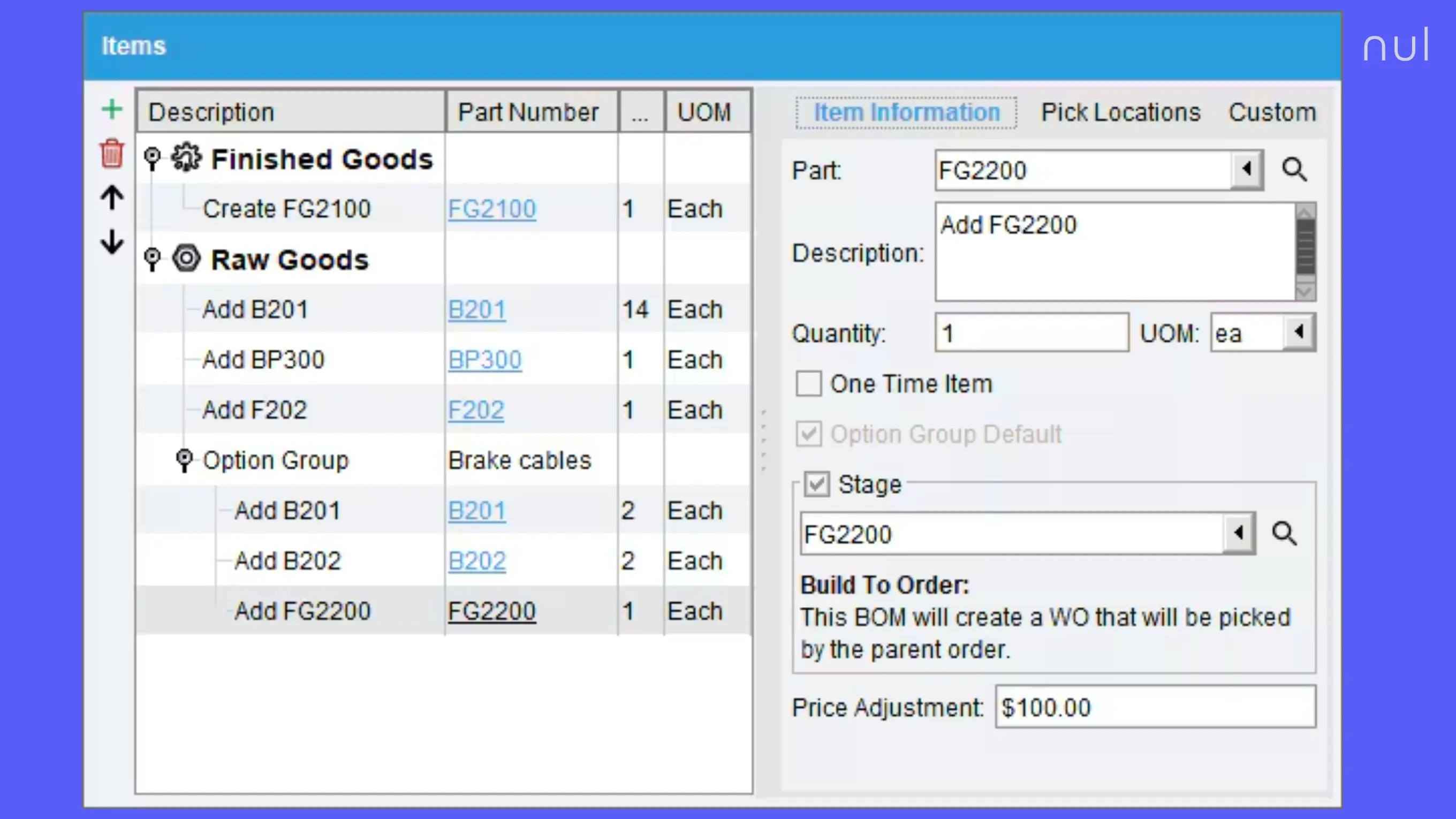
Fishbowl's BOM features are famous for Manufacture and Work Orders.

Fishbowl's BOM features are famous for Manufacture and Work Orders.


Katana

Katana is a cloud-based Material Requirements Planning (MRP) and inventory platform for modern manufacturers (B2C, B2B, and hybrid). It  provides a real-time, centralized view of the entire manufacturing process, linking demand (sales orders) directly to production and raw material management.

The Bill of Materials (BOM) in Katana is a powerful Master Planning feature. When a sales order is placed for a finished garment, the system checks the BOM against stock availability, automatically allocating materials, and suggesting accurate purchasing and production deadlines.

Key BOMs features:

  • Create multi-level BOMs with subassemblies, ideal for layered garments.

  • Manage both the finished product variants (size/color) and the raw materials (BOM components).

  • Tie BOMs directly to live inventory so fabric, trim, and packaging consumption updates stock levels and drives reordering. 

  • Use the BOM to prioritize manufacturing tasks based on sales order deadlines and the availability of all required raw materials

  • Automatically track manufacturing costs based on the BOM and associated production operations.
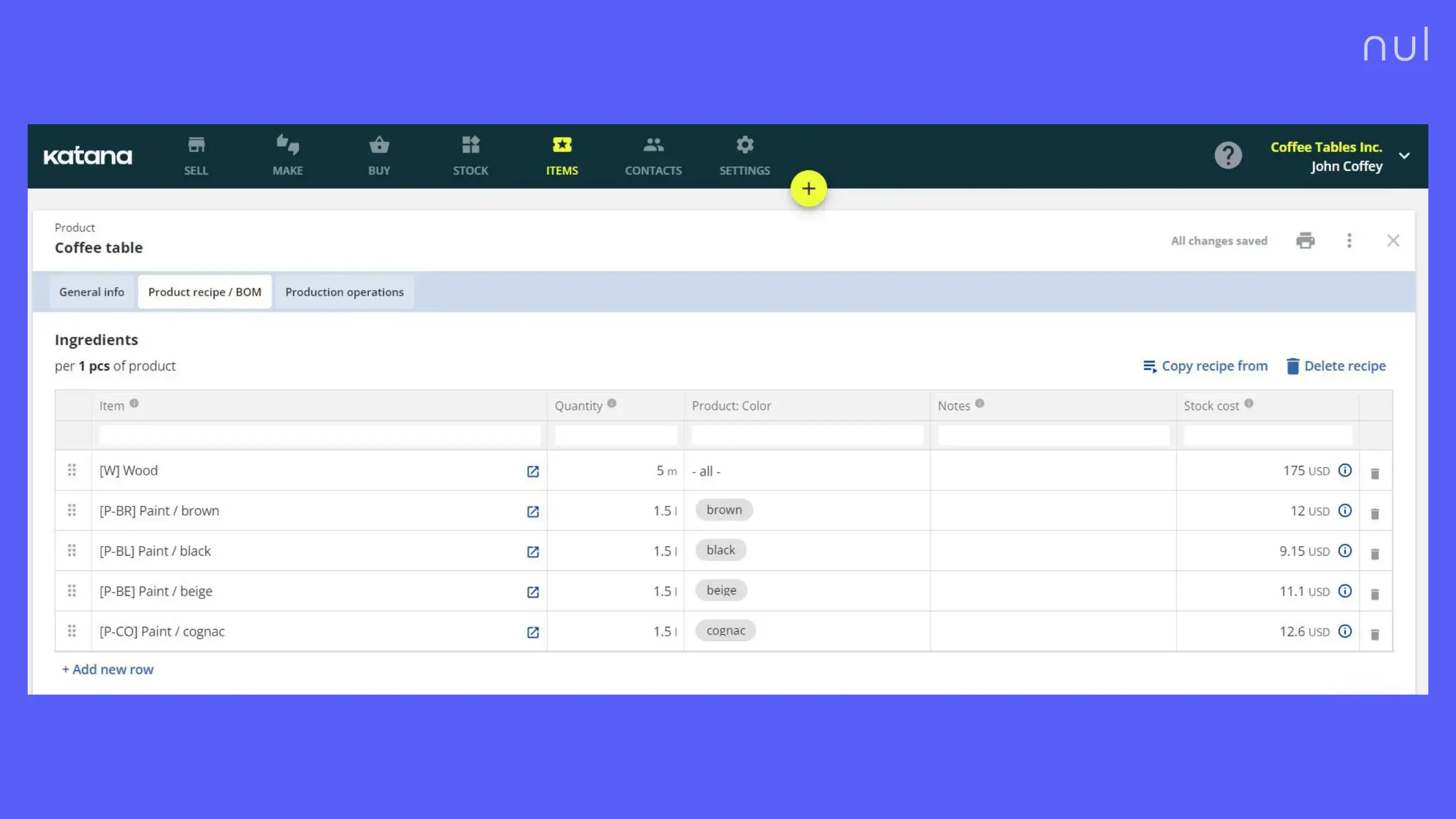
The Bill of Materials (BOM) in Katana is a powerful Master Planning feature.

The Bill of Materials (BOM) in Katana is a powerful Master Planning feature.


Cin7

Cin7 is an inventory and order management platform for omnichannel brands. The system's manufacturing module (often Cin7 Core) focuses on the concept of Assemblies (driven by the BOM), which simplifies the creation of finished goods, kits, and multi-packs.

The Cin7 BOM helps manage the costs and inventory consumed during simple manufacturing or kitting operations. This tool is suitable for fashion brands that assemble finished garments or create multi-item product kits.

Key BOM features:

  • Support different BOM types (assembly, production, make-to-order) 

  • Map labor and machinery directly to BOMs to see capacity, efficiency, and the real cost of producing each style. 

  • Use make-to-order BOMs to manage customized garments (e.g., embroidery, prints, or special finishes).

  • Manage product families so variations like sizes, colors, and styles are grouped under one parent, keeping inventory and BOMs aligned for fashion assortments.

  • A well-structured BOM helps ensure necessary components are always available, reduce stockouts and prevent overstocking of specific parts.
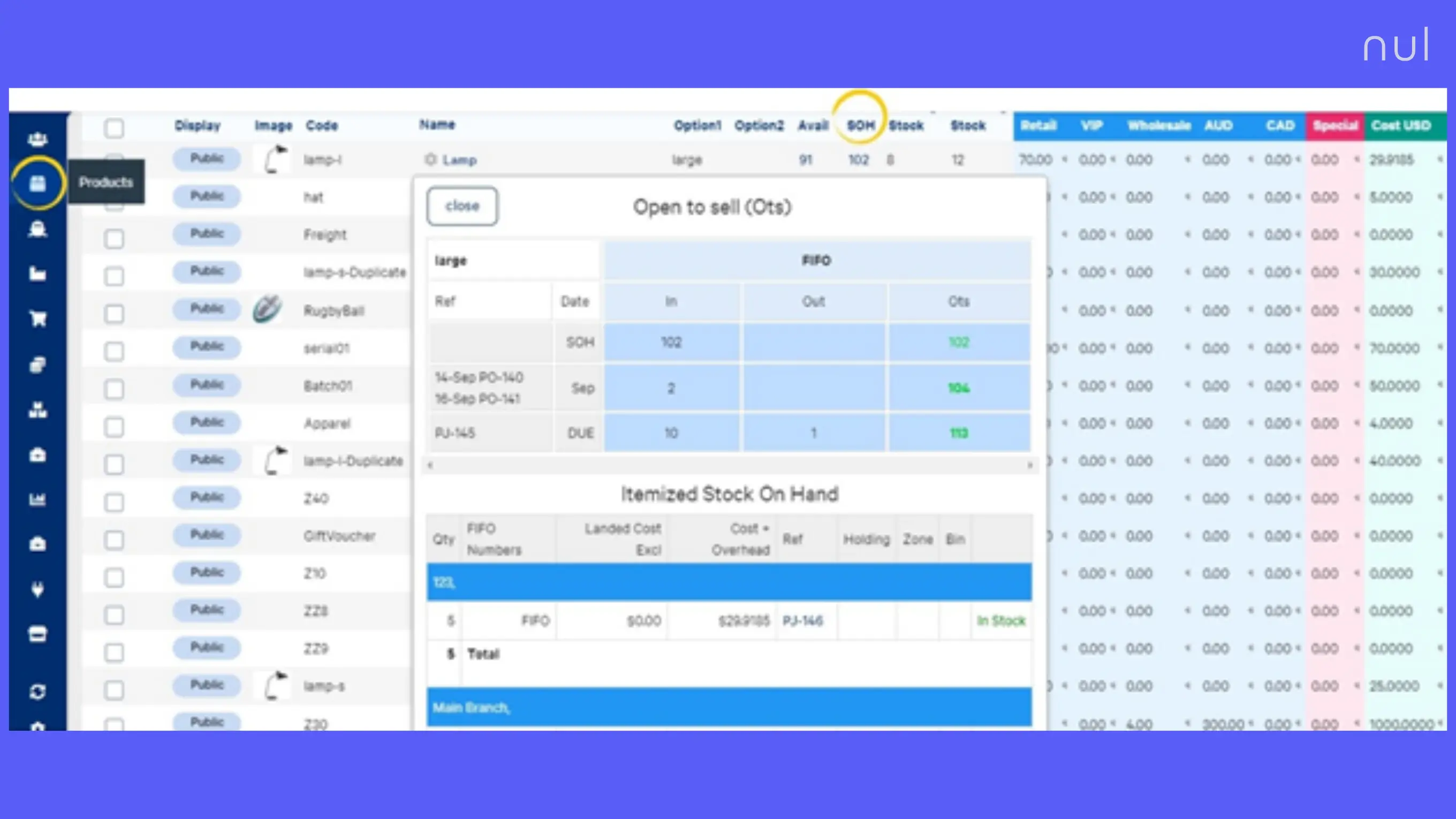
The Cin7 BOM helps manage the costs and inventory.

The Cin7 BOM helps manage the costs and inventory.


OpenBOM

OpenBOM is a cloud-based BOM and product data platform that connects design, sourcing, and production in a single source of truth. Despite being widely used in engineering and manufacturing, it also fits fashion brands that need to control complex product structures and multiple external manufacturers or suppliers.

In OpenBOM, the Bill of Materials sits at the center of the workflow. BOMs are built from shared catalogs that store every item’s description, supplier, and cost, then organized into flexible product structures.

Key BOMs features:

  • Create flexible, multi-level BOMs linked to shared catalogs of materials and components, including supplier and cost data.

  • Integrate BOMs with CAD and other design tools so product structures and changes flow directly from design into OpenBOM.

  • Automatically calculate and roll up cost information from the raw material level up through all sub-assemblies to determine the final product cost.

  • Easily add custom properties (columns) to items and BOMs to handle the rich, non-standard data required for apparel.

  • Collaborate with internal teams and suppliers in a cloud workspace where everyone sees and edits the same live BOM.
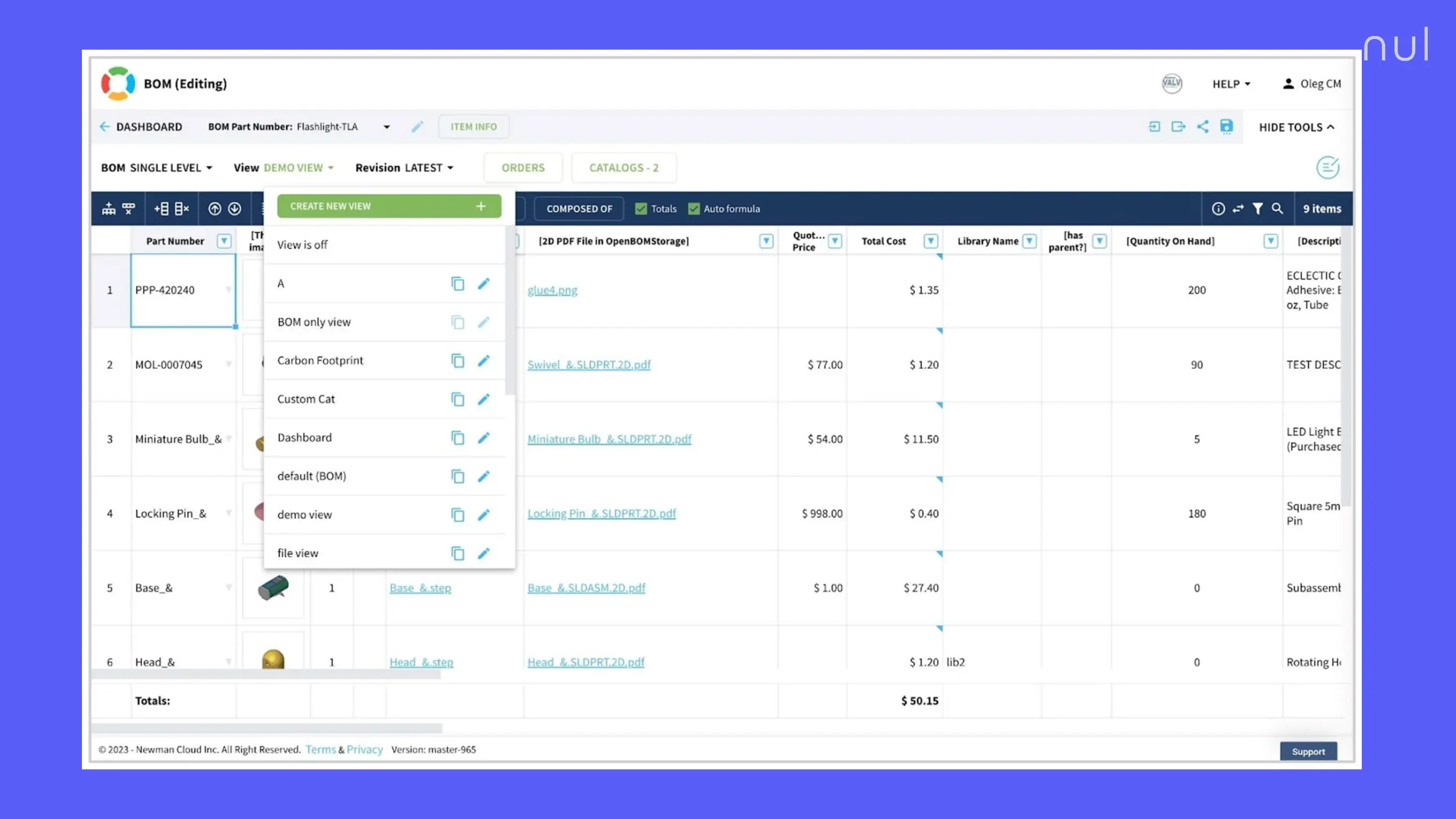
The Bill of Materials sits at the center of the workflow in OpenBOM.

The Bill of Materials sits at the center of the workflow in OpenBOM.


MRPeasy

MRPeasy is a Material Requirements Planning (MRP) and ERP solution for small and mid-sized manufacturers. Its strength lies in complex manufacturing control and precise costing tools that are easy to implement and use.

The MRPeasy BOM is central to its planning modules, allowing brands to manage complex configurations, track wastage, and quickly calculate costs for quoting new styles. There are many BOM options like single-level for basic styles, multi-level for layered garments, and even matrix for configurable products or size/color grids.

Key BOMs features:

  • Create single-level and multi-level BOMs with any number of components, including sub-assemblies.

  • Use matrix BOMs and product configurators to manage parameters and variations, then automatically generate BOMs for each configuration.

  • Support disassembly and co-product BOMs to handle cutting rolls of fabric into many pieces or breaking down kits into components.

  • Link BOMs directly with production routings, so operations and material needs form one connected production model.

  • Leverage version control and revision history to track BOM changes over seasons, capsules, or fit updates.

>> Read more: Top 8 Best Raw Material Inventory Management Software
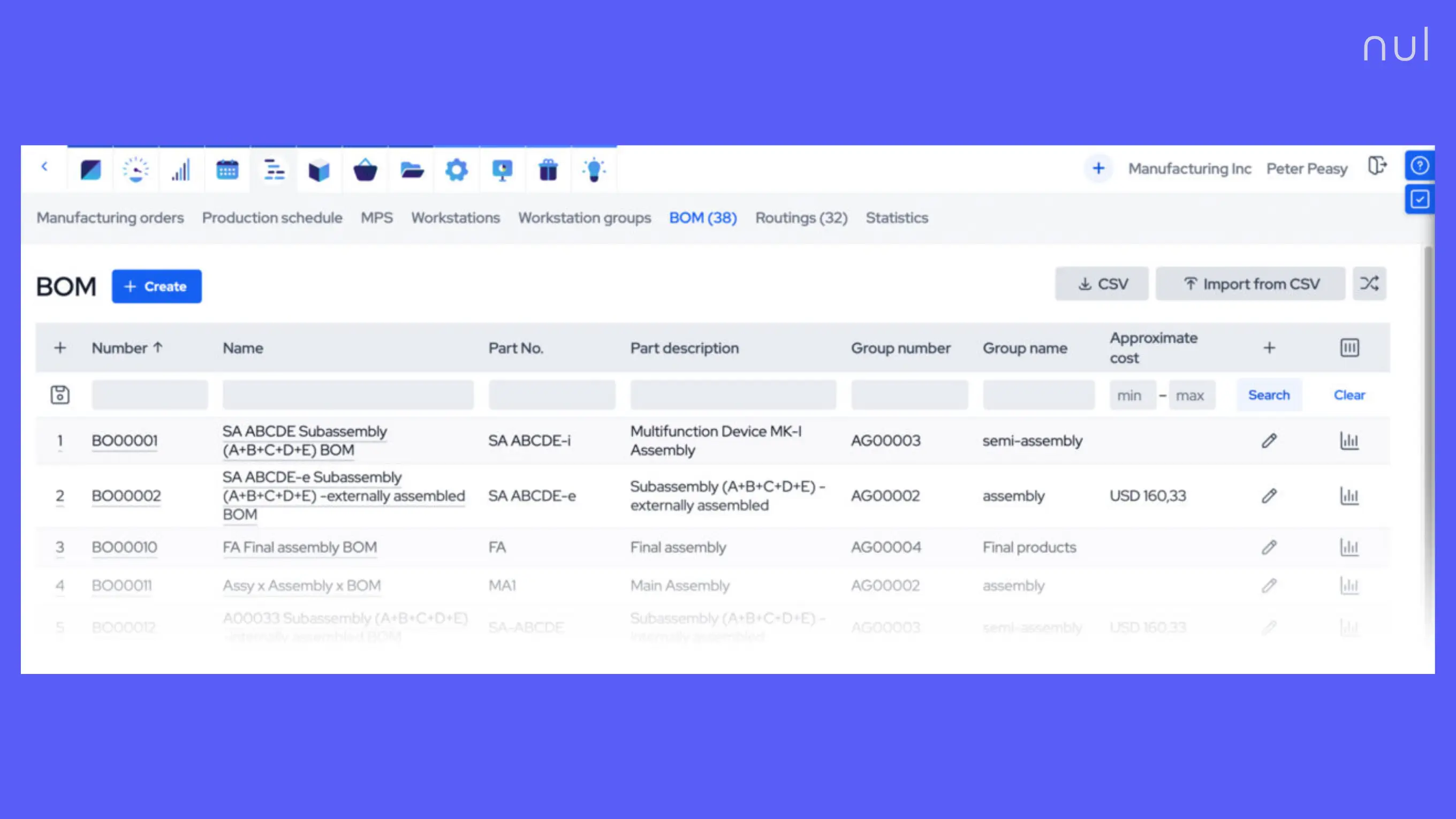
The MRPeasy BOM is central to its planning modules.

The MRPeasy BOM is central to its planning modules.


Conclusion

For modern manufacturing and fashion brands, an inventory management software with Bill of Materials (BOM) feature is the single most important factor for profitability and scale.

The reviewed software shows that the BOM is not only a static list of ingredients into a dynamic, but also an interconnected data structure. Choosing the right platform means linking the software's BOM strengths with your operational needs like:

  • Costing accuracy

  • Real-time production

  • Complex products & design control

Ultimately, a strong BOM ensures that every garment produced is cost correctly, every raw material is ordered precisely, and every SKU maintains its target margin. Hope you will have a suitable solution for your brands.

Nūl Content Team
Nūl Content Team

Article by

Nūl Content Team

An Experienced Research & Knowledge Team

An Experienced Research & Knowledge Team

The Nūl Content Team combines expertise in technology, fashion, and supply chain management to deliver clear, practical insights. Guided by Nūl’s mission to end overproduction, we create content that helps brands forecast demand more accurately, optimize inventory, and build sustainable operations. Every piece we publish is grounded in real-world experience, ensuring it’s both credible and actionable.

LinkedIn Profile