" height="22.21672870003851px" id="z3WvM4hhx" transform="translate(0 7.783)" width="44.5160044463523px"/><path d="M 0 0 L 2.973 0 L 2.973 29.237 L 0 29.237 Z" fill="rgb(51, 51, 65)" height="29.23683002950565px" id="JHCCz3Moo" transform="translate(52.332 0)" width="2.9732091795568465px"/><path d="M 0 0 L 18.335 0 L 18.335 2.973 L 0 2.973 Z" fill="rgb(88, 93, 247)" height="2.9732091795568505px" id="TtL1Ujsfx" transform="translate(26.217 3.072)" width="18.334926489198978px"/><path d="M 0 1.817 C 0 0.813 0.813 0 1.817 0 C 2.82 0 3.634 0.813 3.634 1.817 C 3.634 2.82 2.82 3.634 1.817 3.634 C 0.813 3.634 0 2.82 0 1.817 Z" fill="rgb(88, 93, 247)" height="3.633967846768943px" id="E_sZ1ZJZP" transform="translate(57.862 26.217)" width="3.6339678467688827px"/></g></svg>)
Phantom Inventory in Fashion: Causes, Impacts, and Solutions
Phantom inventory (aka ghost inventory) refers to stock that appears in your inventory system but does not physically exist in your warehouse, store, or backroom.

Nūl Content Team
An Experienced Research & Knowledge Team
The Nūl Content Team combines expertise in technology, fashion, and supply chain management to deliver clear, practical insights. Guided by Nūl’s mission to end overproduction, we create content that helps brands forecast demand more accurately, optimize inventory, and build sustainable operations. Every piece we publish is grounded in real-world experience, ensuring it’s both credible and actionable.

Table of contents
Across fashion retail, accuracy is everything. Whether you run a boutique with 5 stores or a global omnichannel management brand, every decision like buying, allocation, replenishment, or forecasting depends on knowing exactly how much stock you have.
But when your system claims you have 12 units of a SKU, and your store team finds only 3, you’re experiencing phantom inventory. Also known as ghost inventory, this invisible error distorts your data, inflates your stock levels, and quietly harms sales, margins, and customer trust. This guide breaks down what phantom inventory is, why it happens, how it impacts fashion brands, and practical steps to fix it.
What is Phantom Inventory?
Phantom inventory refers to stock that appears in your inventory system but does not physically exist in your warehouse, store, or backroom. It is always a situation where the system counts more units than what is actually on-hand. Phantom inventory is also commonly called ghost inventory, ghost excess inventory, or ghost surplus inventory.
In short: Phantom inventory = Inventory recorded in your system but missing in real life.
Common examples of phantom inventory in fashion:
SKU-level error: System shows 18 units of a bestseller dress, but only 5 are actually on-hand.
Size-level error: A product shows full size runs online (XS–XL), but S and M are actually out-of-stock.
Color-level error: “Black” shows available due to mis-scanning, but only “Navy” exists.
Phantom inventory is a specific type of inventory discrepancy where the system shows more stock than what physically exists. Meanwhile, regular inventory discrepancies are broader mismatches that can go in either direction physical stock being higher or lower than the system. Both share similar causes, but the key difference is that phantom inventory is always an overcount, while general discrepancies include both overcounts and undercounts.
What Are the Root Causes of Phantom Inventory?
Phantom inventory can develop at any stage of the inventory lifecycle. In fashion—where size, color, seasonality, and velocity matter—these issues become even more complex.
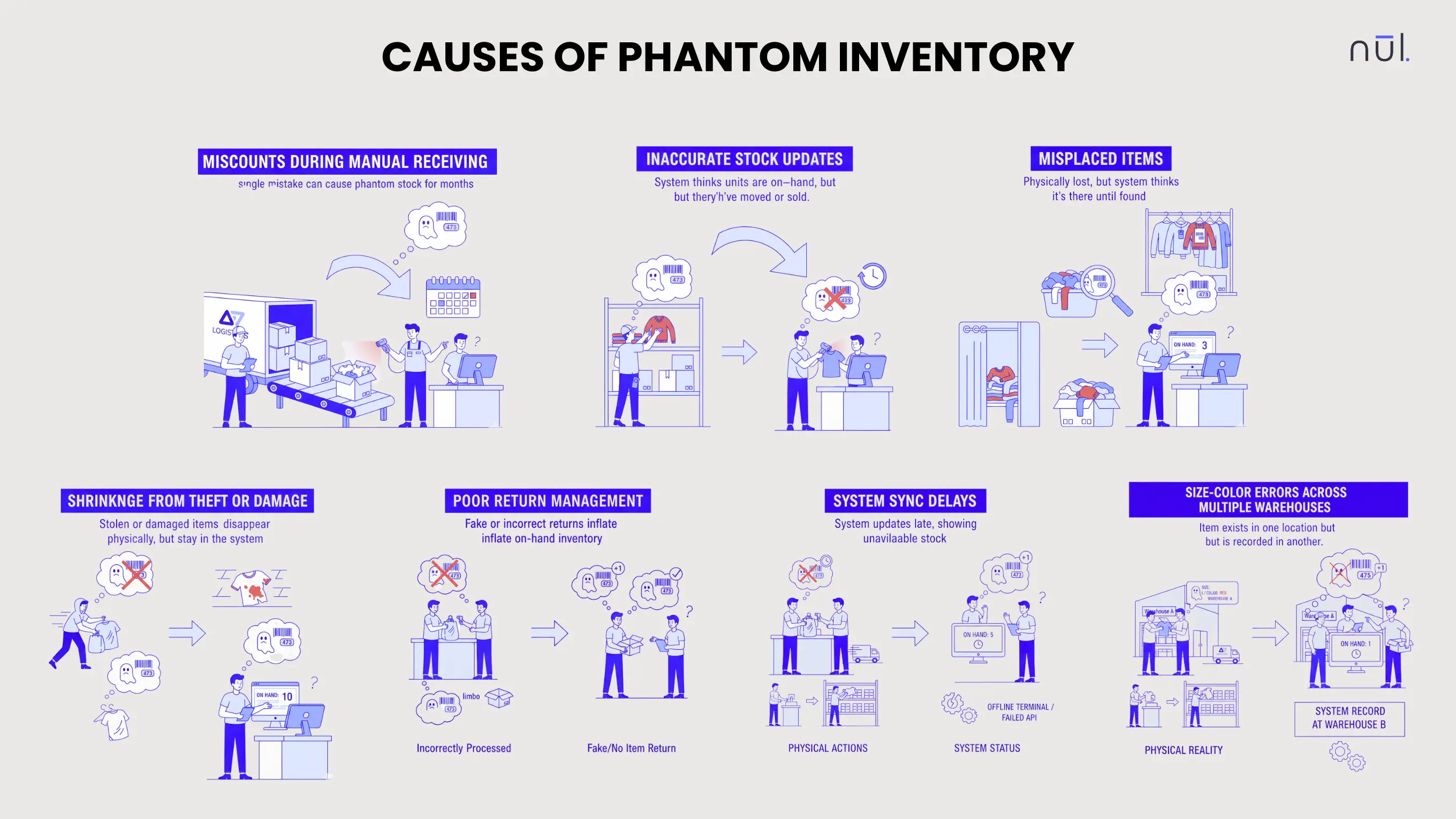
Miscounts During Manual Receiving: When shipments arrive, staff may miscount units, miss whole cartons, or sign off quantities that do not match what was physically delivered. A single mistake at receiving can cause phantom stock to follow that SKU for months.
Inaccurate Stock Updates: If staff forget to scan items or scan the wrong barcode during put-away or checkout, phantom inventory can happens as the system thinks units are still on-hand even though they’ve already moved or sold.
Misplaced Items: Products buried in fitting rooms, returns bins, mixed boxes, or the wrong rack are "lost" physically. The system count is correct in this situation, but poor visibility makes it appear phantom until the item is found.
Shrinkage From Theft or Damage: Stolen, damaged, or misplaced items disappear physically but stay in the system unless logged properly. This is one of the biggest contributors to phantom counts.
Poor Return Management: Incorrectly processed returns get counted twice or remain in limbo. Also, fake or incorrect returns get checked into the system even though no real item exists, causing on-hand inventory to inflate.
System Sync Delays: Sales, picks, transfers, or online orders happen physically, but the system updates late due to offline terminals or failed API pushes, leaving the system showing stock that’s no longer available.
Size–Color Errors Across Multiple Warehouses: A unit might physically exist in Warehouse A but accidentally get recorded as received at Warehouse B. The result is Warehouse B has phantom stock on the system.
What Are the Root Causes of Phantom Inventory?
How Phantom Inventory Impacts Fashion Brands?
Phantom inventory destroys operational reliability. Even small gaps can compound into major financial losses.
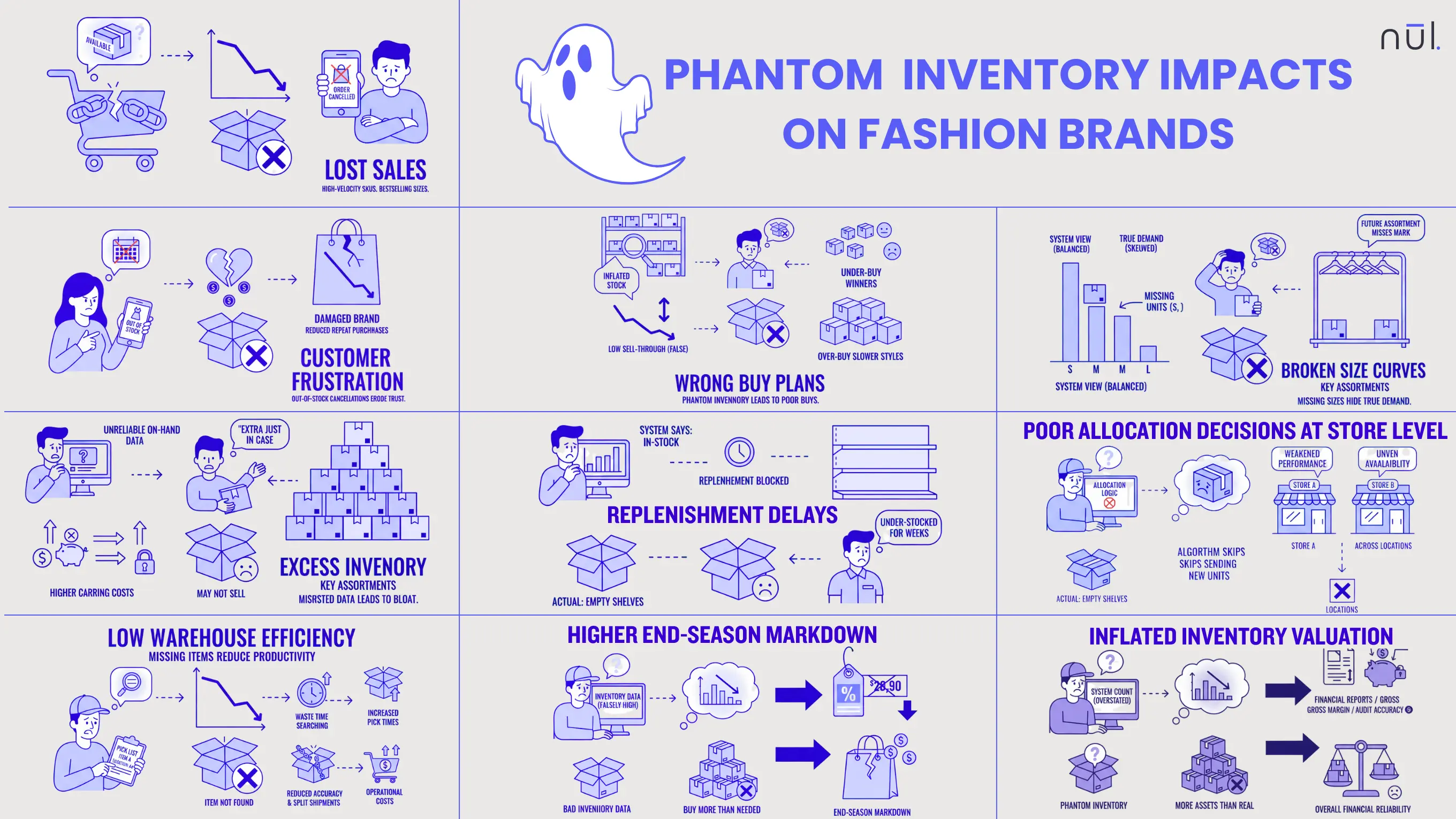
Lost Sales: When the system says an item is available but it isn’t, customers place orders that cannot be fulfilled. Every cancelled order equals a lost sale, often for high-velocity SKUs and bestselling sizes.
Customer Frustration: Out-of-stock cancellations erode trust quickly. In fashion, where customers often buy based on timing or styling needs, these disappointments reduce repeat purchases and damage the brand experience.
Wrong Buy Plans: Phantom inventory inflates on-hand numbers. This makes sell-through percentages appear lower than they truly are, leading planners to believe products aren’t performing. As a result, they under-buy winners and over-buy slower styles in future seasons.
Broken Size Curves in Key Assortments: Missing units in certain sizes, especially core sizes like S or M, hide the true demand pattern. The system assumes the size curve is balanced, but the real customer preference is skewed, causing future assortments to miss the mark.
Excess Safety Stock: When teams cannot trust their on-hand data, they compensate by ordering “extra just in case.” This creates bloated inventory, higher carrying costs, and increased capital tied up in stock that may not sell.
Replenishment Delays: Automated replenishment depends on accurate stock levels. If the system thinks stores still have inventory (that doesn't actually exist), replenishment never triggers, leaving stores under-stocked for days or weeks.
Poor Allocation Decisions at Store Level: Allocation logic relies heavily on accurate store on-hand numbers. If the system believes a store has stock that is not physically there, the algorithm will skip sending new units, weakening store performance and creating uneven availability across locations.
Low Warehouse Efficiency: Pickers waste time searching for items that the system claims exist. This increases pick times, reduces order accuracy, and forces last-minute substitutions or split shipments raising operational costs.
Higher End-Season Markdown: Bad inventory data leads planners to buy more than needed early in the season. When sell-through appears weak (due to phantom stock), they repeat the mistake in the next buy, creating overstock that must be cleared through discounts at season-end.
Inflated Inventory Valuation: Because phantom inventory overstated the system count, financial reports show more assets than the business actually holds. This affects gross margin reporting, audit accuracy, and overall financial reliability.
How Phantom Inventory Impacts Fashion Brands?
How to Solve Phantom Inventory in Fashion?
Reducing phantom inventory requires a mix of process discipline, automated checks, and technology.
Run Cycle Count Corrections
Frequent cycle counts like daily, weekly, or by priority SKU help identify errors before they turn into long-term phantom stock. Spot-checking fast-moving items, high-value SKUs, and core sizes prevents small gaps from snowballing across channels.
Monitor Mismatch Alerts
Use systems that automatically flag SKU-level mismatches between expected on-hand inventory and actual counts. Alerts let store teams or warehouse staff investigate issues immediately, instead of discovering them days or weeks later during a full inventory audit.
Scan Items for Stock Updates
Barcodes or RFID should be mandatory for all movement like receiving, put-away, picking, packing, transfers, checkout. Do not allow manual adjustments unless approved. Ensure every movement has a recorded scan so the system updates instantly.
Use AI-Driven Inventory Software
AI can identify patterns that humans miss:
sudden drops in specific sizes
sell-through patterns that don’t align with on-hand stock
repeated discrepancies in certain stores or SKUs
These anomaly detections help teams catch phantom inventory early and prevent it from impacting planning and replenishment.
Verify Quantities at Receiving
Count cartons, verify size–color breakdowns, and confirm purchase order (PO) accuracy before signing off. Only receive stock into the system after verification to avoid overcounting. Even a small receiving overcount immediately creates phantom stock that can persist across the whole season.
Process Returns Cleanly
Returns often re-enter the system incorrectly. To avoid inflated stock counts, brands should implement:
a dedicated return zone
one-way workflows
mandatory scanning on every returned unit
strict sorting before re-shelving
Having a efficient return management process is really crucial.
Organize Put-Away Locations
Disorganized backrooms create “operational phantom inventory” when items exist physically but can’t be found. Use:
clear signage
size-and-color labels
dedicated bins for new arrivals
separate zones for rejects, returns, and damaged goods
Prevent Shrinkage Losses
Fashion brands should deploy:
security tags on high-value items
CCTV around stockrooms and exits
staff training on handling damaged goods
controlled access to backrooms
Track who accesses stock areas and require incident reporting for missing units.
Check Stock With RFID
Apply RFID tags to items, run regular RFID sweeps across store floors and stockrooms, and use handheld readers to capture discrepancies. Update the system when RFID scans show missing or extra units.
Audit Size–Color Accuracy
Open boxes, verify each unit matches its label, and confirm the correct size–color is stored in the right bin. Re-check transfers and new arrivals to ensure no mislabeling occurred during movement. This is especially important for multi-warehouse or multi-store operations.
How Nūl Helps Fashion Brands Remove Phantom Inventory?
Nūl’s agentic AI platform is built specifically to eliminate data blind spots—phantom inventory included.
Here’s how it helps:
Real-Time Inventory Health Monitoring: Detects mismatches, unusual stock movements, and missing SKUs instantly.
Automated Size–Color Anomaly Detection: Flags broken size curves and incorrect stock updates across stores or warehouses.
AI-Driven Replenishment & Allocation: Prevents replenishment delays caused by false on-hand data.
Unified Inventory Across Channels: Syncs online, retail, and warehouse data into one accurate system of record.
Cleaner Return Workflows: Identifies duplicate returns and prevents inflated on-hand numbers.
Cycle Count Recommendations: Suggests targeted SKUs for recounting—no full audit needed.
With Nūl, brands reduce operational losses, protect margins, and make replenishment decisions confidently.
Conclusion
Phantom inventory or ghost inventory may be “invisible,” but its impact on fashion is massive—lost sales, broken size curves, inaccurate buys, and unnecessary markdowns.
The good news? With the right processes and AI-driven tools, brands can eliminate phantom stock, unlock higher accuracy, and run truly demand-driven operations.
For fashion brands looking to scale across stores, channels, and seasons, fixing phantom inventory isn’t just a nice-to-have—it’s foundational.
Looking for more? Dive into our other articles, updates, and strategies





Let's show you how