" height="22.21672870003851px" id="z3WvM4hhx" transform="translate(0 7.783)" width="44.5160044463523px"/><path d="M 0 0 L 2.973 0 L 2.973 29.237 L 0 29.237 Z" fill="rgb(51, 51, 65)" height="29.23683002950565px" id="JHCCz3Moo" transform="translate(52.332 0)" width="2.9732091795568465px"/><path d="M 0 0 L 18.335 0 L 18.335 2.973 L 0 2.973 Z" fill="rgb(88, 93, 247)" height="2.9732091795568505px" id="TtL1Ujsfx" transform="translate(26.217 3.072)" width="18.334926489198978px"/><path d="M 0 1.817 C 0 0.813 0.813 0 1.817 0 C 2.82 0 3.634 0.813 3.634 1.817 C 3.634 2.82 2.82 3.634 1.817 3.634 C 0.813 3.634 0 2.82 0 1.817 Z" fill="rgb(88, 93, 247)" height="3.633967846768943px" id="E_sZ1ZJZP" transform="translate(57.862 26.217)" width="3.6339678467688827px"/></g></svg>)
Perpetual vs Periodic Inventory System: Which to Choose?
A perpetual inventory system tracks inventory in real time with technology, while a periodic inventory system updates stock only at set intervals with manual counts.

Nūl Content Team
An Experienced Research & Knowledge Team
The Nūl Content Team combines expertise in technology, fashion, and supply chain management to deliver clear, practical insights. Guided by Nūl’s mission to end overproduction, we create content that helps brands forecast demand more accurately, optimize inventory, and build sustainable operations. Every piece we publish is grounded in real-world experience, ensuring it’s both credible and actionable.

Table of contents
Inventory accuracy has become a non-negotiable requirement for modern businesses, especially in fashion, where fast-moving styles, sizes, and channels create constant stock movement. Choosing the right inventory tracking method affects your ability to forecast demand, replenish on time, avoid stockouts, and keep financial statements clean.
Two systems dominate inventory management today: perpetual vs periodic inventory systems. This guide breaks down what they are, the difference between them, examples, advantages and disadvantages, and how fashion brands can choose the right approach.
What Are Perpetual and Periodic Inventory Systems?
Perpetual Inventory System
A perpetual inventory system continuously records every inventory movement (purchases, sales, returns, transfers) as it happens, then updates stock levels and COGS in real time. It usually relies on POS systems, barcode/RFID scanners, and inventory/ERP software for automated stock movement logs. Of course, this system requires more technology, setup, and process discipline.
In simple terms: perpetual = live inventory tracking.
Periodic Inventory System
A periodic inventory system tracks inventory only at specific intervals (e.g., monthly, quarterly, or annually), then updates inventory records and calculates COGS using formulas. Between counts, the business does not track each movement in detail.
This system can be done with basic tools, manual stock counts, and physical audits. It’s simpler and cheaper to run, but inventory and COGS figures are only accurate after each count, not in real time.
In simple terms: periodic = inventory updated only when you count it.
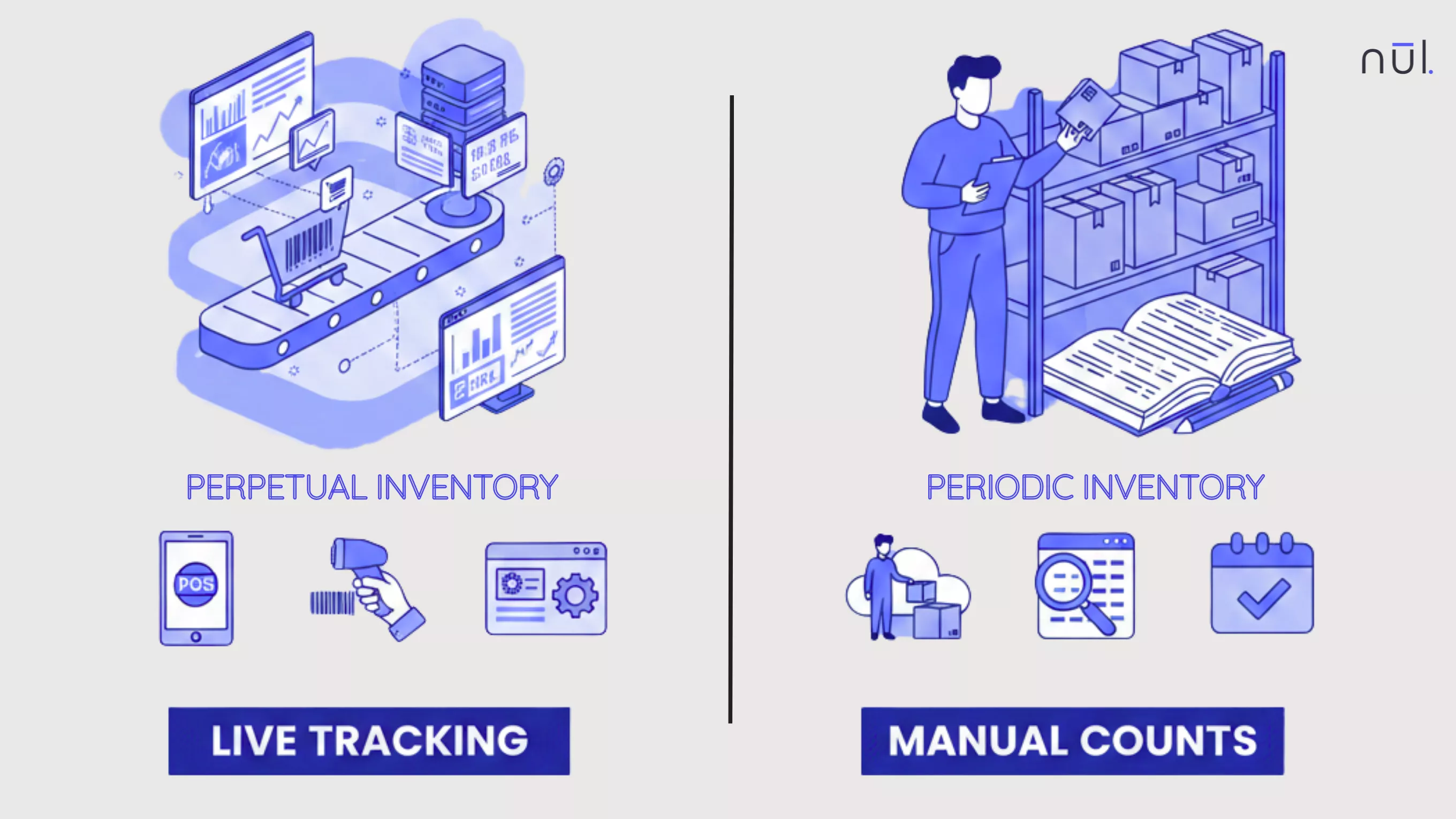
Perpetual and Periodic Inventory Systems
Perpetual vs Periodic Inventory System Advantages and Disadvantages
Advantages
Perpetual Inventory System:
Real-time visibility: As stock levels update instantly, you can open the system at any time and see how many units are available, what is on order, and what is running low without waiting for a physical count.
Better control: It's easier to detect discrepancies between system data and what is actually on the shelf because every movement is recorded. Shrinkage, mis-picks, and receiving mistakes show up as variances quickly, so the team can investigate and correct issues before they grow.
Improved forecasting: Detailed transaction history is stored by SKU, channel, and location, so planners have clean, granular data for a clearer picture of true demand patterns. You can set better reorder points, safety stock, and purchasing plans.
Ideal for multi-channel/multi-location management: Keeps all channels and locations synced if a business has several warehouses, stores, or online channels. Stock movements are reflected across the network, which reduces double-selling, backorders, and the need for manual spreadsheets to reconcile inventory between places.
Automation-friendly: Integrates with POS, WMS, Shopify, ERP really well. These integrations support automated reordering, low-stock alerts, and digital workflows, cutting down on manual admin tasks.
Periodic Inventory System:
Simple to operate: Minimal setup and processes for teams to run day to day. Staff just focus on basic selling and purchasing activities without scanning every movement or relying on complex software Training is also simple because staff only need to learn how to count items correctly, record the numbers, and hand them off for entry at the end of each period.
Lower upfront cost: No tech infrastructure needed for scanners, handheld devices, and integrated platforms. Instead, they can be managed using clipboards, spreadsheets, or simple accounting tools.
Suitable for small or low-volume businesses: Works well for business with a small number of SKUs, limited sales, or only one location.
Disadvantages
Perpetual Inventory System:
Higher cost: Requires investment in inventory or ERP software, barcode or RFID scanners, and integration work with existing tools. Besides, there may be ongoing subscription, support, and hardware maintenance costs.
Training required: To keep data accurate, staff must follow defined workflows, scan items at the right time, and use the system correctly. If people skip steps, share logins, or work around the process, the information in the system becomes unreliable and the benefits of real-time tracking are reduced.
Risk of data errors: A wrong barcode, an incorrect SKU, faulty scans or integrations can affect many transactions very fast. Without regular checks, these errors can ripple through locations, making stock figures and reports misleading.
Periodic Inventory System:
Low visibility between counts: You don’t know true stock until the next count. Every sale, return, and loss changes the true inventory, but the records stay unchanged until the next count. Managers often make purchasing and fulfillment decisions based on old numbers, which can hide problems for weeks or months.
Higher risk of stockouts and overstocks: Blind spots lead to poor buying decisions, like reordering too late or buying too much. And the results are empty shelves for fast movers, excess stock for slow movers, and more guesswork in purchasing.
Difficult for forecasting: Data is often outdated, so you can't see real trends, such as sudden demand changes or seasonal spikes at the SKU level, especially in fast-moving categories.
Labour-intensive counts: Requires shutting down sections to count manually. As the number of SKUs or locations grows, these counts become more time-consuming, more expensive, and more prone to counting errors.
What’s the Difference Between Perpetual and Periodic Inventory Systems?
Below is a simplified view of how both systems differ:
Aspect | Perpetual Inventory System | Periodic Inventory System |
|---|---|---|
Tracking method | Automated (with modern software) | Manual (physical counts) |
Update frequency | Real-time updates with each transaction | One update at the end of each period (weekly, monthly,..) |
Technology | POS, scanners, inventory/ERP software | Sheets, pens, counts, basic apps |
COGS calculation | Recorded per sale | COGS = |
Accuracy | Higher, with good processes and cycle counts | Lower, depends on count quality; gaps between counts |
Cost | Higher setup and running cost | Lower setup cost |
FIFO/LIFO use | Applies FIFO/LIFO continuously per transaction | Applies FIFO/LIFO once at period end |
Best for | Large businesses with high transaction and inventory volumes. | Smaller businesses with low inventory volume. |
Tracking Method
Perpetual: Tracks automatically every inventory movement (purchases, sales, returns, transfers, write-offs) as it happens using modern software. So the system keeps a running record of quantities and often value.
Periodic: Tracks manually inventory by taking physical counts at scheduled intervals (for example, month-end or year-end) and updating stock levels based on those count results rather than on each individual movement.
Frequency of Adjustments
Perpetual: Updates inventory and COGS continuously, with each sale, purchase, or adjustment posting its own entry and changing balances in real time.
Periodic: Updates inventory and COGS at the end of the chosen period, using summary entries based on beginning inventory, total purchases, and the latest physical count.
Stock Visibility
Perpetual: Shows stock levels in real time, giving current quantities by SKU and location whenever someone checks the system.
Periodic: Shows stock levels as of the last physical count, so visibility reflects the most recent count date rather than the latest transactions. So, visibility is limited until the next count.
Technology Requirement
Perpetual: High. Relies on POS terminals, barcode or RFID scanners, inventory or WMS software, and often integrations with eCommerce and ERP platforms to capture and sync transactions automatically.
Periodic: Low. Relies on simple tools such as printed count sheets, manual tallies, and spreadsheets or basic accounting software to record counted quantities at each inventory date.
COGS Calculation
Perpetual: COGS is updated with each transaction. Calculates COGS at the time of each sale by removing the cost of the sold items from inventory and posting it directly to COGS.
Periodic: COGS is computed at the end of the period using the formula:
Beginning Inventory + Purchases – Ending Inventory = COGS, then posts a single adjustment for the whole period.
Accuracy
Perpetual: High accuracy if systems sync correctly.
Periodic: Lower accuracy; prone to discrepancies.
Cost
Perpetual: High initial investment because of using dedicated software, scanners or mobile devices, integrations, and ongoing subscriptions or support services.
Periodic: Low cost due to using existing staff and basic tools, avoiding large investments in specialized inventory technology.
>> Read more: 16 Best Cost Reduction Strategies in Inventory Management
Inventory Valuation Methods (LIFO/FIFO)
You can use LIFO or FIFO in both systems, but:
Perpetual: Applies FIFO or LIFO continuously, updating cost layers with each sale so that the system removes the oldest layer first under FIFO or the newest layer first under LIFO.
Periodic: Applies FIFO or LIFO at period end, using purchases and ending inventory to assign costs in one calculation that determines both ending stock value and COGS for the period.
When to Choose Perpetual vs Periodic Inventory System?
Choose Perpetual If You Are:
A retail or fashion brand: You manage many SKUs, sizes, and colors, and need to know exactly what is available on the shelf and in the backroom to avoid lost sales and markdowns.
An e-commerce store: Your online store must show accurate stock to prevent overselling and cancellations, especially when you run campaigns, flash sales, or marketplaces.
A brand with multiple outlets or warehouses: You move stock between locations and need a single, real-time view of inventory across all stores, warehouses, and channels.
A manufacturer dealing with materials + BOM: You track raw materials, components, and finished goods, and need to see how production and BOM consumption affect stock at every stage.
A business requiring real-time stock accuracy: You rely on up-to-date data for purchasing, fulfillment, stock allocation, and forecasting, and cannot afford to wait for month-end counts to make decisions.
Choose Periodic If You Are:
A small boutique: You have a limited number of items and low daily transactions, so counting stock periodically is enough to keep control without complex systems.
A seasonal business: Your main activity happens in specific seasons, and you can schedule full counts before and after each season instead of tracking every movement in real time.
A low-volume store: Sales, returns, and deliveries are infrequent, making continuous tracking unnecessary; periodic counts can still give you a reasonably accurate picture.
A business without frequent stock movement: Inventory sits mostly still, and changes are easy to follow manually, so you can rely on occasional counts rather than real-time systems.
Someone operating with limited technology: You do not have POS integrations, scanners, or inventory software, and still fine with using basic tools, spreadsheets, and manual processes.
FAQs
1. Is periodic inventory outdated?
Not necessarily. It still works for small, low-volume, or seasonal businesses with minimal SKUs. But for fast-moving retail, perpetual is far more effective.
2. Can I switch from periodic to perpetual easily? What are the steps?
Yes, of course. You can totally switch, but it should be done in a structured way. The typical steps include:
Conducting a full physical count
Cleaning and standardising your SKU data
Integrating POS/WMS/Shopify
Setting up scanning workflows
Training your team
Running both systems in parallel for a short period
3. How often should I do physical counts under a perpetual system?
Even with real-time tracking, you should still do:
Cycle counts weekly/monthly
Full counts annually
4. Does perpetual mean I never need to count?
No. Perpetual reduces errors, but does not eliminate them. Physical counts validate the system and catch discrepancies.
Conclusion
In the end, neither perpetual nor periodic inventory is “right” for everyone. Perpetual works best when you need real-time accuracy, multiple locations, and scalable operations. Periodic is still a solid choice for small, simple, or seasonal businesses with limited stock and low transaction volume.
The key is to match your inventory system to your business size, complexity, and growth plans—and to keep your data clean and regularly checked, whatever method you use.
Looking for more? Dive into our other articles, updates, and strategies




Let's show you how