" height="22.21672870003851px" id="z3WvM4hhx" transform="translate(0 7.783)" width="44.5160044463523px"/><path d="M 0 0 L 2.973 0 L 2.973 29.237 L 0 29.237 Z" fill="rgb(51, 51, 65)" height="29.23683002950565px" id="JHCCz3Moo" transform="translate(52.332 0)" width="2.9732091795568465px"/><path d="M 0 0 L 18.335 0 L 18.335 2.973 L 0 2.973 Z" fill="rgb(88, 93, 247)" height="2.9732091795568505px" id="TtL1Ujsfx" transform="translate(26.217 3.072)" width="18.334926489198978px"/><path d="M 0 1.817 C 0 0.813 0.813 0 1.817 0 C 2.82 0 3.634 0.813 3.634 1.817 C 3.634 2.82 2.82 3.634 1.817 3.634 C 0.813 3.634 0 2.82 0 1.817 Z" fill="rgb(88, 93, 247)" height="3.633967846768943px" id="E_sZ1ZJZP" transform="translate(57.862 26.217)" width="3.6339678467688827px"/></g></svg>)
What are Stockouts in Fashion? Causes, Costs, and Prevention
A stockout in fashion retail happens when a specific size, color, or style is no longer available for a customer to buy.

Nūl Content Team
An Experienced Research & Knowledge Team
The Nūl Content Team combines expertise in technology, fashion, and supply chain management to deliver clear, practical insights. Guided by Nūl’s mission to end overproduction, we create content that helps brands forecast demand more accurately, optimize inventory, and build sustainable operations. Every piece we publish is grounded in real-world experience, ensuring it’s both credible and actionable.
Table of contents
A stockout happens when a product or a specific SKU is unavailable while customers still want to buy it. In fashion, inventory carries risks that other retail categories don't face in the same way.
Some characteristics of fashion are: selling seasons are short, most styles never get reordered once the original production run sells out, and demand for an item can spike overnight because of a trend on social sites. A stockout on a bestselling style doesn't just cost a sale, it often forces markdowns elsewhere in the assortment to make up the lost revenue.
This guide covers what causes stockouts in fashion retail, what they cost in lost sales, margin, and the forecasting, allocation, and open-to-buy practices that help prevent them.
What is a Stockout in Fashion Retail?
A stockout in fashion retail is when a specific size, color, or style is no longer available for a customer to buy. The product still exists in the assortment, but no unit is left to sell at that store, on that website, or in that size.
In apparel, a stockout rarely means an entire style disappears from the shelf. Because each style breaks down into multiple sizes and colors, a stockout often happens at the SKU level first.
For example, a men's jacket in navy might still show "in stock" online even though every size except 3XL sold out weeks earlier. Retailers who track stockouts only at the style level tend to miss this, since the item still looks available in their reporting.
Style-level stockout: every SKU tied to a style is gone. No size, no color, nothing left to sell under that item.
SKU-level stockout: at least one size or color within a style is gone, while other SKUs in the same style remain in stock.
Most stockout problems in fashion start at the SKU level. A bestselling style can look healthy in a style-level inventory report while missing the exact sizes that drive most of its sales.
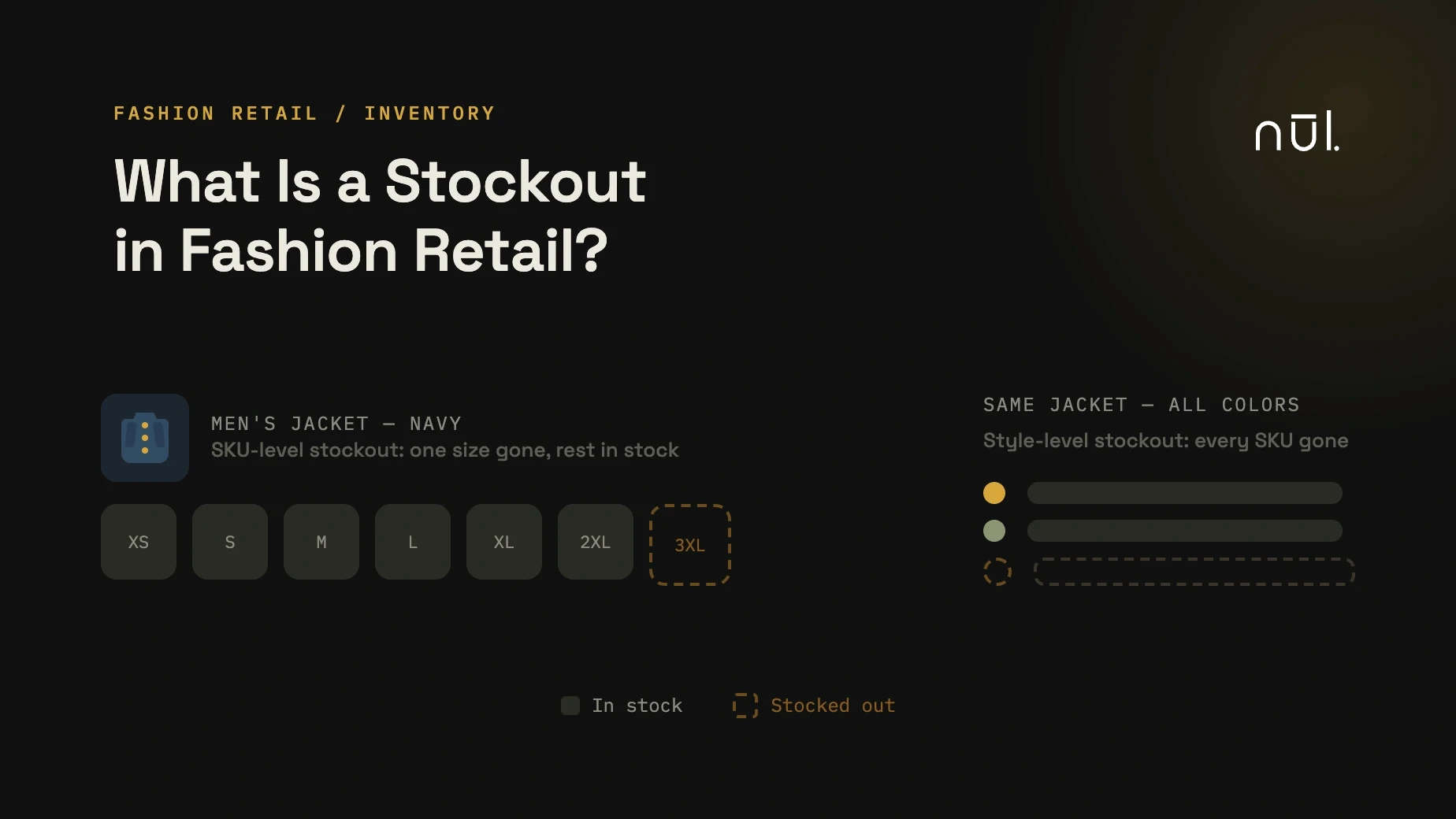
A stockout is when a specific SKU is no longer available for a customer to buy.
Common Causes of Stockouts in Fashion Retail
Most stockouts in fashion retail trace back to one of eight causes.
Inaccurate SKU-level demand forecasting
A size curve is the expected demand split across the sizes in a style, for example 10% XS, 25% S, 30% M, 25% L, 10% XL.
When a retailer forecasts demand only at the style level, they can buy the right total quantity while still buying the wrong mix, ordering too few mediums and too many extra-larges. The style shows enough total stock, but the sizes customers actually want run out first.
Weak open-to-buy (OTB) planning
Open-to-buy, or OTB, is a budgeting method that sets how much inventory a retailer can purchase within a set period, based on planned sales, existing stock, and markdowns.
When OTB budgets are set without real sell-through data or fixed too far in advance, buyers cannot respond quickly when a style sells faster than expected. By the time they approve a reorder, the buying window may have closed, and new stock may arrive too late.
Misallocation across stores and channels
A retailer can hold enough total inventory across its network and still run out at individual locations if the wrong stores get the wrong size runs.
For example, a store where customers tend to buy larger sizes may sell out early if it receives the same size distribution as a store with different demand patterns, even while company-wide inventory remains healthy.
Lead times longer than the selling season
Fashion styles are often produced in a single run tied to a specific season or trend. If the lead time to produce and ship a reorder is longer than the weeks left in the selling window, reordering isn't a real option once a style starts selling out. The stockout becomes permanent for that season regardless of how quickly the retailer reacts.
Sudden demand spikes from trends or social media
A product mentioned from an influencer, a viral video, or a sudden shift in what's considered fashionable can multiply demand for a specific item within days. Forecasts built on historical sales data can't anticipate this kind of spike, and by the time a retailer notices the sales trend, the inventory to meet it is often already gone.
Supplier, fabric, and factory delays
Delays in raw material sourcing, factory production schedules, or shipping can push a delivery past its planned in-store date. Fashion retailers are especially exposed here because a delayed fabric shipment or a factory backlog can affect an entire seasonal collection at once, not just a single item.
Fragmented data across channels
When online and in-store inventory systems don't update in real time, a product can show as available on a website after the last unit sold in a physical store, or vice versa. Customers place orders against inventory that no longer exists, which shows up as a stockout only after the order is already accepted.
>> Read more: 19 Inventory Management Challenges & Their Solutions
Manual, spreadsheet-based planning processes
Retailers who track size curves, reorder points, and store allocations manually are more likely to miss the early signals of a stockout. Spreadsheets don't flag a fast-depleting size in real time the way automated inventory or forecasting systems do, so the stockout is usually already underway by the time someone notices it in a manual inventory report.
What Stockouts Cost Fashion Retailers?
A stockout's cost rarely ends with the missed sale. In fashion retail, it tends to trigger a chain of secondary costs that show up in other parts of the business weeks or months later.
Lost full-price sales and margin
The most direct cost is the sale itself. When a size or color sells out, that revenue is gone unless the customer is willing to wait for a restock or buy a different item. Because fashion styles often aren't reordered mid-season, this isn't a delayed sale, it's a sale the retailer never recovers, at full margin.
The deep markdown strategies
When a bestselling style stocks out, the units that would have driven planned revenue are no longer available to sell. To close the resulting gap against sales targets, buyers often mark down other, slower-moving styles earlier or more deeply than planned.
A stockout on one winning item can end up reducing margin across several unrelated styles in the same collection, not just the one that sold out.
Wholesale penalties and lost shelf space
Fashion brands that sell through wholesale accounts are usually held to a fill rate: the percentage of an order they're able to ship complete and on time.
Falling short of the fill rate a retail partner requires can trigger financial chargebacks, and repeated misses can put future orders and shelf space at that account at risk, independent of the lost revenue from the stockout itself.
Customer churn and lost brand loyalty
A customer who can't find their size or color once can try again later. A customer who hits the same problem repeatedly tends to start shopping at a competitor's site or store instead, particularly for basics and repeat-purchase items where brand loyalty depends on consistent availability.
How to Prevent Stockouts in Fashion Retail?
Preventing stockouts in fashion retail means fixing the planning decisions that cause them, not just reacting once a size or color is already gone. The strategies below address the causes covered earlier, from forecasting through supplier management.
Forecast demand at SKU level: Use forecasting tools that build size curves from sell-through velocity, comparable styles, and current sales data, updating automatically as new data comes in.
Build an open-to-buy process: Review OTB budgets weekly or biweekly against actual sell-through, so buyers can shift spend toward outperforming styles before those styles run out.
Set in-season chase and reorder triggers based on real lead times: Base reorder points on actual supplier production and shipping time, not a rounded estimate, so buyers know exactly how many weeks of selling season remain to act once a size starts running low.
Optimize allocation and replenishment by store and channel: Allocate initial shipments and replenishment based on each store's or channel's own sales history, rather than an even split across the networks.
Unify inventory visibility across online, in-store, and wholesale: Use a single, real-time inventory view across all channels so a SKU stops selling everywhere the moment the last unit sells anywhere.
Separate safety stock strategy for core and seasonal items: Core, replenishable items like a basic tee restocked every season can carry a standard safety stock buffer because they can be reordered repeatedly. For seasonal fashion items, buy conservatively and rely on fast chase-and-reorder triggers instead of a large upfront buffer, since excess stock on a one-season style becomes markdown risk later.
Diversify suppliers and shorten lead times where possible: Work with more than one supplier for key fabrics or production capacity. Also, favor closer-to-market production for fast-moving or trend-sensitive styles to shorten the window where a stockout can't be fixed in time.
Use pre-order and waitlist tactics to capture demand during a stockout: When a size or color does sell out, a pre-order option or a waitlist that notifies customers when it's restocked keeps the sale from being lost outright. This also gives a retailer a direct, measurable signal of unmet demand for that specific SKU, which is useful data for the next buy or reorder decision.
Use AI-powered inventory and demand-sensing tools across the process. AI-based platforms can flag a fast-depleting SKU, recommend a reorder or reallocation in real time, and adjust forecasts as sales trends shift mid-season, catching risk earlier than a manual or fixed-schedule review would.
>> Read more:
A Complete Guide to Use AI Agents for Inventory Management
Top 10 AI Fashion Inventory Management Software Solutions
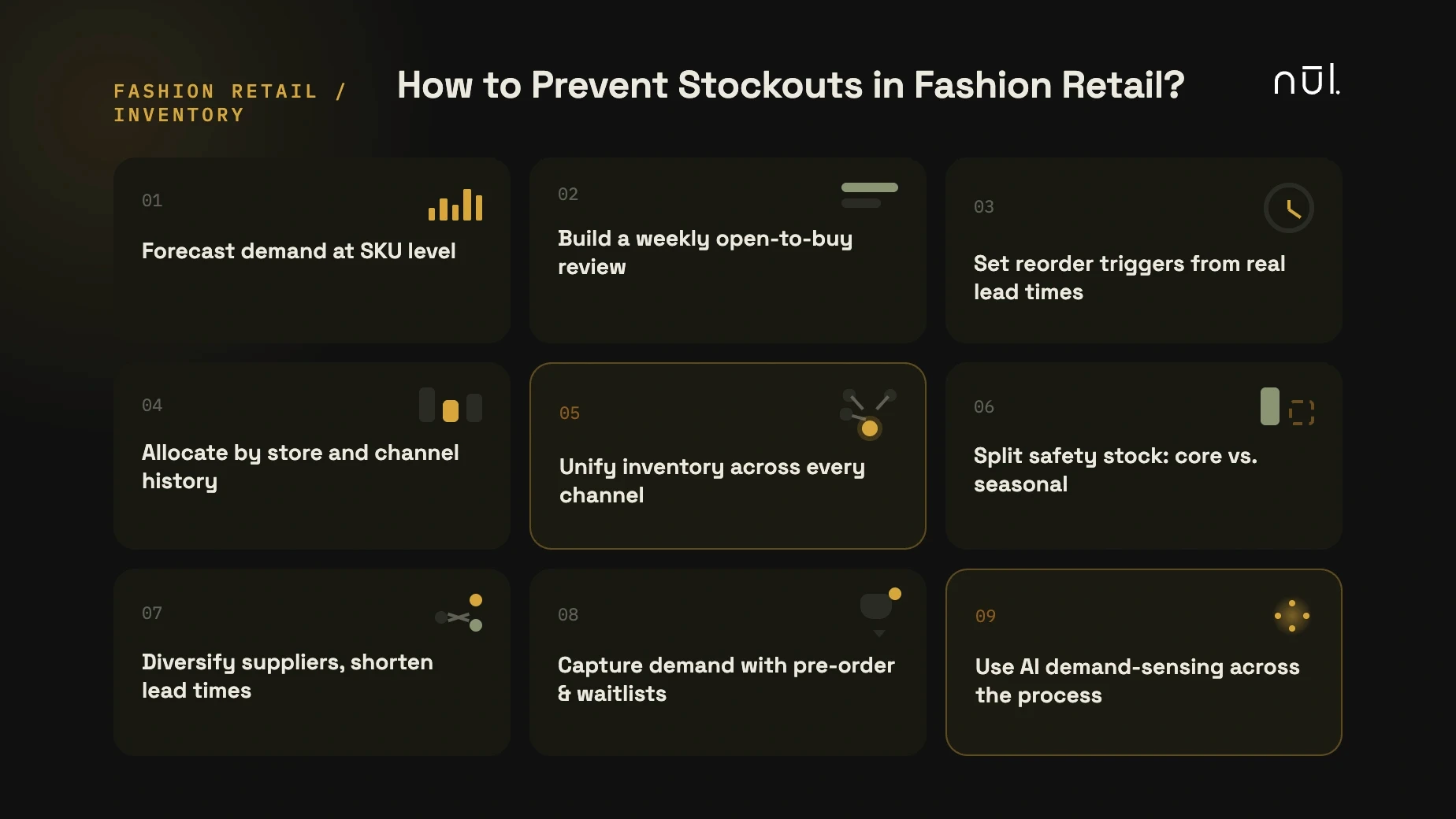
Preventing stockouts in fashion retail means fixing the planning decisions.
How to Measure and Monitor Stockout Risk?
Stockout rate
Stockout rate formula:
Stockout rate = number of out-of-stock SKUs ÷ total number of SKUs |
|---|
Track stockout rate weekly at the SKU level, broken out by category, season, or store, so one well-stocked hero item doesn't mask a chronic problem elsewhere in the assortment.
Fill rate
Formula:
Fill rate = units shipped ÷ units ordered, expressed as a percentage |
|---|
Fill rate metric matters most for fashion brands selling through wholesale accounts, where missing a partner's required fill rate can trigger chargebacks or affect future order volume.
In-stock rate
Formula:
In-stock rate = number of in-stock SKUs ÷ total number of active SKUs |
|---|
A style can show a 100% in-stock rate at the style level while missing its best-selling sizes, so tracking in-stock rate by SKU surfaces the gap before it shows up as a drop in sales.
Common Mistakes Fashion Retailers Make When Trying to Prevent Stockouts
Some of the most common responses to a stockout end up causing a different inventory problem, rather than fixing the original one.
Overcorrecting into excess inventory. After a bad stockout, it's common to swing hard toward safety stock across the board. Adding a blanket buffer to every SKU, rather than targeting it toward unpredictable items, usually just shifts the problem: fewer stockouts, more markdowns, and capital tied up in styles that were never at real risk of selling out.
Treating every SKU with the same replenishment rule: A single set of reorder points and safety stock levels applied across the whole assortment ignores how differently core and seasonal items behave. A replenishable basic and a one-season trend item carry very different stockout and overstock risk, and a uniform rule tends to underserve one or the other.
Ignoring channel-specific demand signals: A style can sell completely differently online versus in a specific store, or across different wholesale accounts. Allocating and replenishing based on company-wide averages, instead of each channel's own sales pattern, leaves faster channels running out while slower ones sit on excess stock of the same item.
Reordering without accounting for the size curve. When a reorder is placed, it's easy to default to the style's original size ratio rather than the ratio that's actually selling. If demand has skewed toward specific sizes since launch, reordering the original mix reproduces the same size-level stockout the retailer was trying to fix.
How Nūl Helps Fashion Retailers Prevent Stockouts?
Nūl helps fashion retailers close the gap between planned inventory and actual demand at the SKU level, using the same forecasting, allocation, and replenishment principles covered in this guide.
SKU-level demand forecasting: Builds size and color forecasts from sell-through velocity and comparable style performance, instead of a flat size-curve split.
Store- and channel-level allocation: Recommends how much of a style each location should receive based on its own demand pattern, not a company-wide average.
Connected stockout and overstock risk: Flags where a safety stock buffer meant to prevent one risk is likely to create the other.
Differentiated safety stock rules: Lets planners set buffers deliberately for core items versus seasonal styles, instead of one rule for the whole assortment.
Conclusion
Fashion retailers can't eliminate every stockout, since some causes, like a viral demand spike or a factory delay, sit outside their control. What they can control is how quickly a stockout gets caught and acted on, which comes down to forecasting and tracking inventory at the size and color level instead of the style level, and setting a safety stock strategy that fits how core and seasonal items actually behave.
Getting that balance right protects full-price sales and the margin a rushed markdown would otherwise give away.
Looking for more? Dive into our other articles, updates, and strategies




Let's show you how